Table of Contents
Navigation for judicial typing examination preparation.
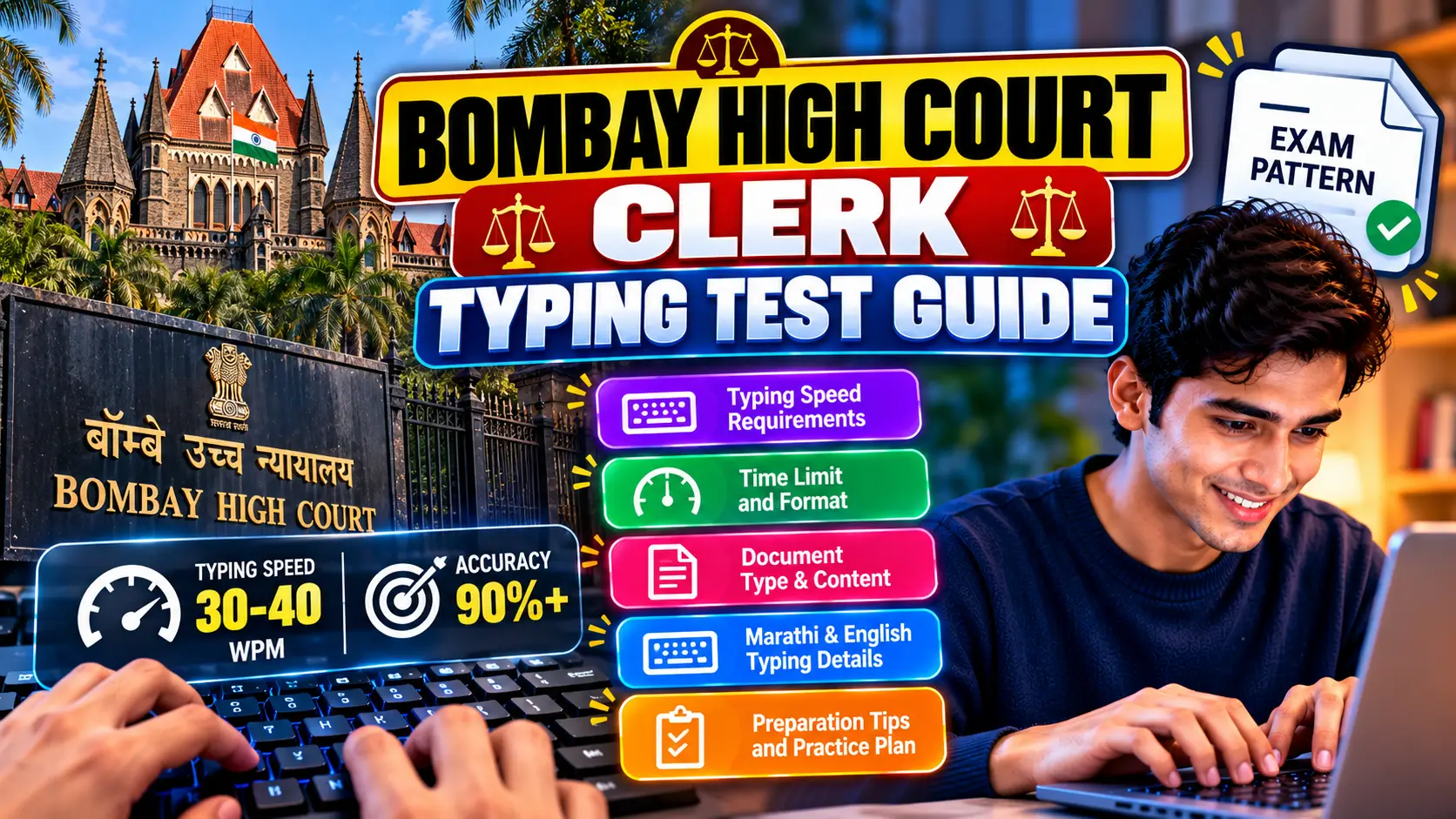
The Clerk-Typist recruitment process conducted by the High Court of Judicature at Bombay and subordinate District Courts in Maharashtra is known for maintaining the most exacting typing standards in the state. Unlike routine commercial qualifications, court typists transcribe legal judgments, evidentiary affidavits, and urgent writ orders where a single misplaced punctuation mark or incorrect figure can distort statutory meaning.
Consequently, the typing skill test is not merely an assessment of raw velocity. Examiners enforce stringent deduction mechanisms that penalize careless editing, uncorrected substitutions, and uncontrolled backspacing. In this guide, we examine the formal structure of the test, explore the critical differences between general exams and court evaluations, and provide targeted drills to secure a qualifying score.
01. Exam Pattern & Speed Benchmarks
The Clerk examination typically involves a two-stage evaluation: an initial English typing skill test followed by a regional Marathi typing assessment for shortlisted candidates. Candidates who clear screening written examinations must prove consistent mechanical proficiency on designated test terminals.
As detailed in our foundational Government Typing Test Guide, court examinations adhere strictly to standardized keystroke quotas calculated over strict durations:
| Section | Speed Benchmark | Duration | Keystroke Quota | Min. Qualifying Marks |
|---|---|---|---|---|
| English Typing Test | 40 WPM | 10 Minutes | ~2,000 Keystrokes (400 Words) | Typically 20 Marks |
| Marathi Typing Test | 30 WPM | 10 Minutes | ~1,500 Keystrokes (300 Words) | Typically 20 Marks |
While commercial examinations such as the state basic certificate (examined in our Court & GCC-TBC Preparation Guide) divide marks between letter formatting and statement alignments, High Court tests concentrate almost entirely on pure, uninterrupted legal passage transcription.
02. Backspace Policy & Strict Editing Rules
The single greatest stumbling block for candidates trained on casual online typing portals is editing behavior. Online practice widgets reward typists who aggressively mash the backspace key to fix fleeting mistakes. In judicial examinations, software modules either disable the key completely or levy a cumulative speed penalty for excessive corrections.
If your typing cadence relies on automatic correction loops, you will struggle under official court conditions. To break this habit, study the deliberate psychological drills in our guide on How to Fix Backspace Addiction in Typing.
Exam Center Software Mechanics
Court evaluation software generally locks text word by word or restricts cursor backward movement beyond the currently active token. Hitting space commits the typed word permanently. If you discover a misspelling two words later, you cannot return to edit it without incurring penalty deductions.
03. Error Deduction Matrix (Full vs. Half Mistakes)
In judicial transcription scoring, deductions are divided into distinct penalty classifications based on how severely the typo compromises textual fidelity:
- Omission: Skipping an entire word or passage sentence.
- Substitution: Replacing a legal term with an incorrect synonym.
- Addition: Typing superfluous words absent from the source.
- Spelling Errors: Any character omission or transposition within a word.
- Capitalization: Typing lowercase letters instead of proper legal capitals (e.g., typing "court" instead of "Court").
- Punctuation: Missing periods, commas, semicolons, or citation parentheses.
- Spacing Errors: Hitting the spacebar twice between consecutive words.
- Paragraph Indent: Failing to insert the mandatory tab indent at section breaks.
The formula for Net Speed reflects this penalty distribution:
04. English 40 WPM vs. Marathi 30 WPM Expectations
English test passages rely heavily on legal phraseology—such as appellant, respondent, writ jurisdiction, affidavit, and circumstantial evidence. These technical words feature complex letter n-grams that challenge finger muscle memory.
For the Marathi test, the High Court requires proficiency on standardized Unicode formats (predominantly Mangal Font) utilizing the standardized Inscript layout or recognized typing formats specified in the notification. Candidates must master half-letters (जोडाक्षरे), halant management, and complex ligatures without hesitating on key combinations.
05. 5-Week High Court Practice Routine
To reach a safe buffer of 50 WPM in English and 38 WPM in Marathi (ensuring an exam-hall margin above minimum qualifying thresholds), adopt this structured training framework:
- Weeks 1 & 2 (Mechanical Zero-Error Focus): Restrict backspace entirely. Type legal passages slowly at 25–30 WPM, ensuring 99%+ accuracy. Train fingers to anchor precisely to the home row after every stroke.
- Week 3 (Punctuation and Numeric Rigor): Practice case citations containing parenthetical year references, petition numbers, and section symbols. Build rapid numeric row reach.
- Week 4 (Lookahead Buffer Training): Train your eyes to read 2 to 3 words ahead of the word your fingers are striking. This steady visual pacing eliminates hesitation between phrases.
- Week 5 (Full Simulated Mock Sessions): Run strict 10-minute timed mock tests on TypeNest Timed Tests with ambient typing background noise to build concentration under pressure.
Conclusion
Succeeding in the Bombay High Court Clerk typing examination requires respecting the precision of legal text. Velocity is an inevitable byproduct of mechanical discipline, flawless home row anchoring, and calm error control. Begin by eliminating editing crutches and prioritizing clean execution from the first keystroke.
Test your baseline legal transcription speed today on TypeNest Academy.
Last Updated: October 2026
Author: TypeNest Editorial Team