🏛️ Government Exam Guide

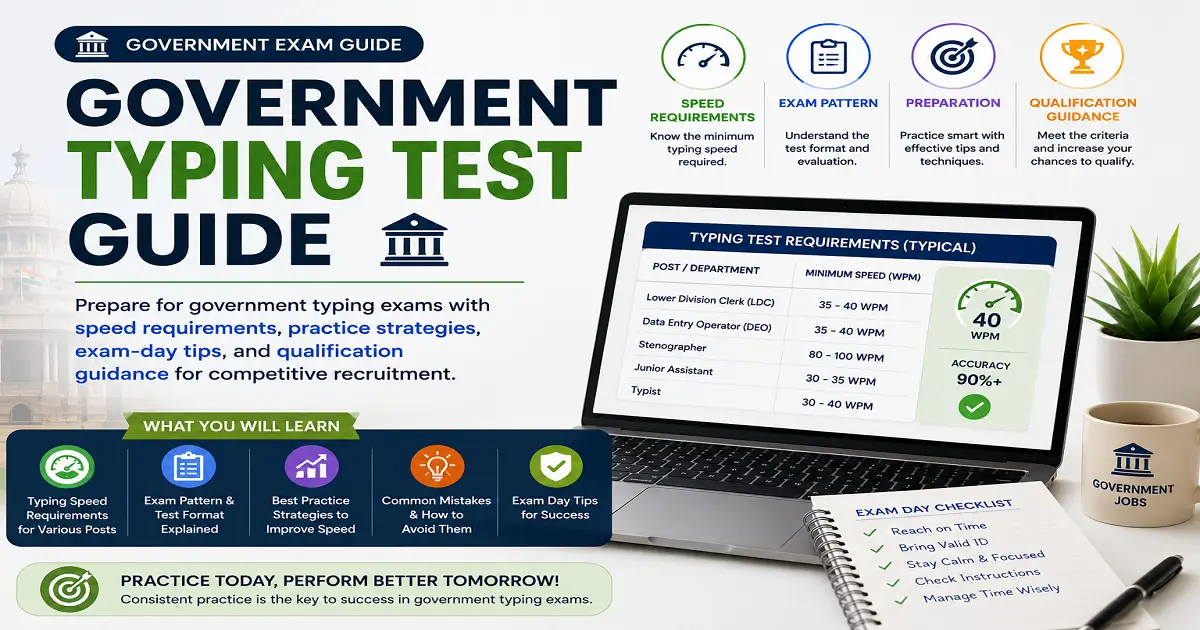
Government Typing Test Guide: Speed Requirements, Exam Pattern & Preparation Tips

Learn government typing test requirements, minimum typing speed, exam patterns, preparation strategies, common mistakes, and practical tips to improve your chances of qualifying for government jobs.

📅 Updated: July 2026 ⏱️ 20 min read 👤 TypeNest Team

📑 Table of Contents

Jump to any section of this complete government typing test guide.

Introduction

A government typing test is often the final step between a candidate and a government job. After clearing written examinations, many recruitment processes require applicants to demonstrate that they can type accurately and comfortably within a specified time limit. Even candidates with excellent theoretical knowledge sometimes fail at this stage because they underestimate the importance of typing practice.

Unlike a regular online typing test, a government typing test is conducted under fixed rules. Candidates must complete a passage within the allotted time while meeting minimum speed requirements and maintaining acceptable accuracy. Depending on the recruitment authority, the examination may be conducted in English, Hindi, or another approved language, making preparation slightly different from general typing practice.

Many aspirants make the mistake of focusing only on achieving the required Words Per Minute (WPM). While meeting the minimum speed is important, consistent accuracy, proper keyboard technique, and confidence under timed conditions are equally essential. Small errors, poor typing habits, or panic during the test can affect your final performance even if you normally type at a good speed.

This complete Government Typing Test Guide explains everything you need to know before appearing for a typing examination. You will learn how government typing tests work, common speed requirements, typical exam patterns, preparation strategies, daily practice plans, and practical tips for performing confidently on exam day.

If you are new to keyboard practice, we also recommend reading our Complete Beginner's Guide to Touch Typing. To understand realistic typing speed targets, explore our Typing Speed Benchmarks Guide. If your goal is to improve overall keyboard performance before the exam, our Complete Guide to Increase Typing Speed and Typing Accuracy Guide provide structured methods to build both speed and accuracy.

What Is a Government Typing Test?

A Government Typing Test is a practical skill assessment used by many government departments to evaluate whether a candidate can type efficiently on a computer within a fixed time limit. Unlike written examinations that measure subject knowledge, this test focuses on keyboard proficiency, speed, accuracy, and the ability to work under exam conditions.

Typing tests are commonly included during recruitment for clerical, administrative, data entry, and office support positions where computer-based work is a major part of the job. Candidates are usually required to type a given passage within a specified time while meeting the minimum speed prescribed in the recruitment notification.

The exact format varies between organizations. Some examinations measure only typing speed, while others evaluate both speed and accuracy. Certain recruitment boards may also conduct the test in multiple languages, depending on the job requirements and official notification.

Purpose of a Government Typing Test

Government offices handle large volumes of digital records, official correspondence, reports, applications, and public documents every day. Employees who can type efficiently complete these tasks more quickly while producing fewer errors.

Instead of relying only on educational qualifications, recruitment agencies use typing tests to verify that candidates possess the practical keyboard skills required for everyday office work.

Who Needs to Take a Government Typing Test?

Typing tests are generally required for positions where computer-based documentation forms an important part of daily responsibilities. Although eligibility differs across departments, these examinations are commonly conducted for administrative and clerical recruitment.

Job Category Typing Test Required
Clerk / LDC / UDC Usually Required
Data Entry Operator (DEO) Required
Junior Assistant Often Required
Office Assistant Often Required
Stenographer Typing + Skill Test
Administrative Support Staff Depends on Recruitment Rules

What Skills Are Evaluated?

Government typing examinations measure more than how quickly you press keys. Examiners are interested in your overall typing performance under pressure. Candidates who maintain steady speed while making very few mistakes generally perform better than those who type quickly but produce frequent errors.

Preparation Tip: Before worrying about official speed requirements, build a strong foundation with proper keyboard technique. Our Complete Beginner's Guide to Touch Typing explains how correct finger placement and muscle memory make government typing test preparation much easier.

Every Recruitment Notification Is Different

One important point to remember is that there is no single typing standard for every government job. Different recruitment agencies, departments, and examinations may specify different typing speeds, test durations, languages, and qualifying criteria.

Always read the official recruitment notification carefully before starting your preparation. Once you understand the required typing standard, you can build a focused practice routine that targets the exact skills needed to qualify.

Why Government Typing Tests Are Required

Government departments process thousands of applications, letters, reports, notices, records, and official documents every day. Most of this work is now performed on computers, making efficient keyboard skills an essential part of many government jobs. A typing test helps recruitment authorities verify that candidates can perform routine office work accurately and within reasonable time limits.

Unlike academic examinations, a typing assessment measures practical ability rather than theoretical knowledge. A candidate may score well in a written exam but still struggle to complete day-to-day administrative work if typing is slow or error-prone. For this reason, many recruitment processes include a separate skill test before the final selection.

Ensuring Workplace Productivity

Government offices rely on timely documentation and accurate record keeping. Employees often prepare official correspondence, update digital databases, draft reports, maintain files, and respond to public requests. Good typing skills allow these responsibilities to be completed more efficiently while reducing unnecessary delays.

Accuracy Matters More Than Speed Alone

Typing quickly is useful only when the work remains accurate. Incorrect names, figures, addresses, or official details can create unnecessary corrections and delay office procedures. That is why many government typing tests evaluate both speed and accuracy instead of rewarding high WPM alone.

Candidate Typing Speed Accuracy Overall Result
Candidate A 45 WPM 98% Reliable and consistent performance.
Candidate B 55 WPM 89% Frequent errors require correction.

For most recruitment exams, maintaining a steady typing rhythm with high accuracy provides a better chance of qualifying than attempting to type as fast as possible.

Practical Skills Are Easy to Measure

A government typing test offers an objective way to evaluate every applicant under the same conditions. Each candidate receives similar text, the same time limit, and identical scoring criteria. This creates a fair assessment of practical keyboard ability without depending on interviews or subjective evaluation.

Supports Digital Governance

As government services become increasingly digital, employees are expected to work with computer-based systems instead of paper records. From online applications to electronic file management, efficient typing has become an everyday requirement in many departments.

Candidates who already possess strong keyboard skills usually adapt more quickly to office software and digital workflows after joining the organization.

Exam Tip: Meeting the minimum typing speed is only part of the preparation. Developing proper keyboard technique, maintaining consistent accuracy, and practicing under timed conditions will improve your confidence during the actual examination. If you need to strengthen these skills, read our Complete Beginner's Guide to Touch Typing and Complete Typing Accuracy Guide.

A Skill That Benefits Your Entire Career

Preparing for a government typing test is not only about qualifying for one examination. Strong keyboard skills continue to benefit employees throughout their careers by making documentation, communication, data entry, and administrative work faster and more efficient.

In the next section, we will examine the typical typing speed requirements used in different government recruitment examinations and explain how to choose a realistic practice target before your exam.

Government Typing Speed Requirements

One of the first questions candidates ask before preparing for a government typing examination is, "How many WPM do I need to qualify?" The answer depends on the recruitment authority, job role, language, and official notification. There is no universal typing speed requirement that applies to every government examination.

Some recruitment boards specify a minimum typing speed in Words Per Minute (WPM), while others define the requirement as a certain number of Key Depressions Per Hour (KDPH). Certain examinations may also include separate standards for English and Hindi typing.

Because recruitment rules are updated from time to time, candidates should always verify the latest requirements in the official notification instead of relying on information shared on social media or unofficial websites.

Typical Government Typing Speed Standards

Although exact requirements vary, the following ranges are commonly seen in many government recruitment examinations.

Exam / Job Type Typical Requirement
Lower Division Clerk (LDC) 30–35 WPM
Junior Assistant 30–35 WPM
Data Entry Operator (DEO) 35–40 WPM or equivalent KDPH
Office Assistant 30–40 WPM
High Court / District Court Posts Varies by recruitment notification
State Government Clerical Posts Depends on department rules
Important: The table above is only a general reference. Always follow the official recruitment notification because typing speed requirements, language options, and qualifying criteria may change between recruitment cycles.

English and Hindi Typing Requirements

Many government examinations allow candidates to appear in either English or Hindi, while some recruitments specify only one language. The required typing speed may also differ depending on the language selected.

Before beginning your preparation, confirm:

Should You Practice Only the Minimum Speed?

No. Preparing only for the minimum qualifying speed leaves very little room for mistakes during the actual examination.

Exam pressure, unfamiliar keyboards, and nervousness can temporarily reduce your typing performance. A candidate who normally types exactly at the required speed may struggle to qualify on exam day.

A better strategy is to practice until your average speed remains comfortably above the official requirement while maintaining good accuracy.

Official Requirement Recommended Practice Target
30 WPM 35–40 WPM
35 WPM 40–45 WPM
40 WPM 45–50 WPM

This additional margin improves confidence and reduces the risk of falling below the qualifying standard during the examination.

Speed and Accuracy Should Improve Together

Many candidates spend weeks trying to increase their WPM but ignore typing accuracy. In government examinations, frequent typing errors can affect your overall performance even if your speed is acceptable.

Aim to develop both skills together. A steady typing rhythm with high accuracy is generally more reliable than typing very fast while making frequent corrections.

Preparation Strategy: If your current speed is below the required standard, first improve your keyboard technique with our Complete Beginner's Guide to Touch Typing. Then increase your speed gradually using the Complete Guide to Increase Typing Speed, while maintaining high accuracy with help from our Typing Accuracy Guide.

Build a Comfortable Safety Margin

The most successful candidates do not prepare just to meet the qualifying speed—they prepare to exceed it consistently. Building a comfortable safety margin through regular practice helps you remain calm under exam conditions and improves your chances of qualifying on the first attempt.

In the next section, we will look at the typical government typing test pattern, including test duration, passage format, scoring, and what you can expect on the day of the examination.

English vs Hindi Government Typing Tests

Many government recruitment examinations allow candidates to choose between English and Hindi typing, while others specify the language in the official notification. Regardless of the language, the objective remains the same—demonstrating that you can type accurately and consistently within the allotted time.

The preparation strategy, however, may differ slightly. English typing generally follows the standard QWERTY keyboard layout, whereas Hindi typing depends on the keyboard layout or input method approved for the examination. Understanding these differences before starting your preparation can save valuable time and help you practice more effectively.

English Typing Tests

English typing tests are the most common format used in government recruitment. Candidates are usually required to type a passage using a standard QWERTY keyboard while maintaining the prescribed speed and accuracy.

Preparation for English typing should focus on developing smooth keyboard control, reducing typing mistakes, and maintaining a steady rhythm throughout the examination.

Hindi Typing Tests

Hindi typing examinations require candidates to use the keyboard layout or typing method specified in the recruitment notification. Before beginning your preparation, make sure you understand which layout will be used during the examination.

Since Hindi typing involves a different keyboard arrangement, candidates should spend enough time becoming familiar with key locations before attempting full-length typing tests.

Key Differences

English Typing Hindi Typing
Uses the standard QWERTY keyboard. Uses the layout specified in the recruitment notification.
Suitable for English-language recruitment. Used where Hindi typing is accepted or required.
Focus on speed, rhythm, and accuracy. Focus on layout familiarity, accuracy, and consistency.
Large variety of online practice material. Practice should match the official exam layout.

Which Language Should You Choose?

Choose the language in which you are most comfortable and that matches the recruitment notification. Switching languages shortly before the examination usually slows progress and creates unnecessary confusion.

If both options are available, continue practicing in the language you use regularly. Consistency is far more valuable than changing your preparation strategy at the last moment.

Preparation Tip: Practice using the same language, keyboard layout, and time limit that will be used in your examination. Simulating real exam conditions helps improve confidence and reduces mistakes on the actual test day.

Prepare According to the Official Notification

Government recruitment agencies may update typing requirements, approved keyboard layouts, or examination software between recruitment cycles. Always rely on the latest official notification instead of assumptions or outdated information.

Once your language and typing standard are confirmed, the next step is building an effective preparation routine. In the following section, you'll learn how to prepare for a government typing test with a practical study plan that improves both speed and accuracy.

How to Prepare for a Government Typing Test

Preparing for a government typing test is different from casual typing practice. The objective is not simply to increase your typing speed but to perform consistently under examination conditions. A well-planned preparation routine helps you build confidence, improve accuracy, and comfortably meet the required typing standard before exam day.

Many candidates begin practicing only a few days before the examination. Unfortunately, keyboard skills cannot be developed overnight. The best results come from regular practice over several weeks, allowing your fingers to develop stronger muscle memory and a steady typing rhythm.

Know the Official Requirements

Before starting your preparation, carefully read the recruitment notification. Understanding the examination rules allows you to focus on the skills that will actually be tested.

Preparing according to the official guidelines prevents unnecessary practice in the wrong format.

Build Strong Keyboard Fundamentals

Candidates often try to increase speed immediately without developing proper typing technique. This usually creates bad habits that become difficult to correct later.

Start by learning correct finger placement, maintaining good posture, and using all fingers consistently. Strong fundamentals make it much easier to improve speed while keeping mistakes under control.

Recommended Reading: If you are still looking at the keyboard while typing, begin with our Complete Beginner's Guide to Touch Typing. It explains home row keys, finger placement, and muscle memory in detail.

Practice Under Exam Conditions

One of the most effective preparation methods is to recreate the actual examination environment. Practice using the same time limit, keyboard, and language whenever possible.

Avoid pausing frequently or correcting every small mistake. Instead, complete each practice session exactly as you would during the real examination.

Practice Method Benefit
Timed typing sessions Builds speed and confidence.
Using the same keyboard regularly Improves familiarity.
Practicing complete passages Develops consistency.
Simulating exam conditions Reduces nervousness.

Balance Speed and Accuracy

Many candidates become obsessed with achieving higher WPM while ignoring typing mistakes. In government typing examinations, consistent accuracy is just as important as speed.

Increase your typing speed gradually while maintaining reliable accuracy. A steady performance throughout the test is far more valuable than starting quickly and making frequent errors.

If you need structured methods for improving both skills, read our Complete Guide to Increase Typing Speed and Complete Typing Accuracy Guide.

Follow a Daily Practice Schedule

Short daily practice sessions produce better results than irregular long sessions. Practicing consistently helps strengthen muscle memory and improves keyboard confidence before the examination.

Daily Activity Recommended Time
Warm-up exercises 5 Minutes
Typing practice 15–20 Minutes
Timed mock test 10 Minutes
Review mistakes 5 Minutes
Preparation Tip: Practice regularly instead of trying to improve everything in one day. Even 30–40 minutes of focused daily practice can produce noticeable improvement before your examination.

Stay Consistent Until Exam Day

Government typing tests reward preparation, not last-minute effort. Candidates who practice consistently develop better keyboard control, maintain their confidence under pressure, and are more likely to qualify comfortably.

In the next section, we'll look at the most common mistakes candidates make during government typing examinations and how you can avoid them.

Common Mistakes Candidates Make During Government Typing Tests

Many candidates fail government typing tests not because they lack typing ability, but because they make avoidable mistakes during preparation or on the day of the examination. Small errors such as poor time management, rushing through the passage, or practicing without a plan can reduce overall performance.

Understanding these common mistakes in advance allows you to prepare more effectively and approach the examination with greater confidence.

1. Practicing Only for Speed

One of the biggest mistakes is focusing entirely on increasing Words Per Minute (WPM) while ignoring accuracy. Typing faster than your comfort level often results in unnecessary mistakes that reduce your final performance.

Instead of chasing a higher speed immediately, build a steady rhythm and increase your performance gradually. Consistent accuracy is often more valuable than a few extra WPM.

2. Ignoring the Official Exam Pattern

Every recruitment notification contains important details about the typing test, including the language, duration, qualifying criteria, and instructions. Some candidates practice using completely different settings and are surprised during the actual examination.

Always prepare according to the latest official notification instead of relying on assumptions or previous recruitment cycles.

3. Not Practicing Under Timed Conditions

Typing comfortably without a timer is very different from completing a passage within a fixed examination time.

Regularly practicing timed typing tests helps you improve pacing, manage pressure, and develop the confidence needed on exam day.

4. Looking at the Keyboard Frequently

Looking down at the keyboard slows your typing rhythm and breaks concentration. During an examination, this habit can cost valuable seconds and increase the likelihood of mistakes.

Learning proper keyboard technique before the exam allows your fingers to locate keys more naturally while your attention remains on the screen.

5. Skipping Daily Practice

Many candidates practice intensively for one or two days and then stop for long periods. Keyboard skills improve through regular repetition rather than occasional long sessions.

Even thirty minutes of focused practice each day is usually more effective than several hours of practice once a week.

6. Using Different Keyboards Every Day

Constantly switching between keyboards with different layouts or key spacing can affect typing consistency. Whenever possible, practice on a keyboard that feels similar to the one likely to be used during the examination.

7. Panicking During the Test

Some candidates lose confidence after making one or two typing mistakes. They begin rushing, which often leads to even more errors.

If you make a mistake, stay calm and continue typing with a steady rhythm. Maintaining concentration usually produces better results than trying to recover lost time immediately.

Common Mistake Better Approach
Typing as fast as possible. Maintain a steady and controlled pace.
Ignoring official instructions. Practice according to the recruitment notification.
Skipping timed practice. Take regular mock typing tests.
Looking at the keyboard. Keep your eyes focused on the screen.
Practicing irregularly. Follow a consistent daily schedule.
Panicking after mistakes. Stay calm and continue typing confidently.
Exam Tip: Treat every practice session like the real examination. Use a timer, avoid distractions, complete the full passage, and review your mistakes only after the test is finished. This builds confidence and prepares you for actual exam conditions.

Learn From Every Practice Session

Every typing test provides useful feedback. Instead of concentrating only on your final score, review where you slowed down, which words caused mistakes, and whether you maintained a consistent pace throughout the test.

Candidates who analyze their practice sessions regularly tend to improve faster than those who simply repeat the same exercises every day.

In the next section, we'll create a practical daily practice plan that helps you prepare systematically for a government typing test while balancing speed, accuracy, and consistency.

Daily Practice Plan for Government Typing Test Preparation

Success in a government typing test is built through consistent daily practice rather than occasional long sessions. Many candidates try to improve their typing speed by practicing for several hours just before the examination, but this approach rarely produces lasting results. A structured routine helps you develop keyboard confidence, maintain accuracy, and gradually increase your typing speed without unnecessary pressure.

The practice plan below is suitable for most government typing examinations. It combines warm-up exercises, speed practice, timed tests, and error analysis to help you prepare systematically.

30–40 Minute Daily Practice Routine

You do not need to spend several hours every day preparing for a typing test. A focused practice session of around thirty to forty minutes is usually enough to make steady progress.

Practice Activity Time Purpose
Finger Warm-up 5 Minutes Loosen fingers and improve coordination.
Basic Typing Practice 10 Minutes Build consistency and typing rhythm.
Timed Typing Test 10 Minutes Practice under exam conditions.
Review Mistakes 5 Minutes Identify weak areas and common errors.
Targeted Practice 10 Minutes Improve difficult words, keys, or patterns.

Practice in Exam Conditions

At least a few times each week, practice exactly as you would during the real examination. Set a timer, type the complete passage without interruptions, and avoid pausing to correct every small mistake.

Training under realistic conditions improves concentration, builds confidence, and helps you become comfortable working within the official time limit.

Track Your Weekly Progress

Keeping a simple practice record makes it easier to monitor improvement and stay motivated. Instead of judging yourself based on one good or bad session, review your progress over several weeks.

Week Average Speed Accuracy Practice Days
Week 1 32 WPM 95% 5 Days
Week 2 35 WPM 96% 6 Days
Week 3 38 WPM 97% 6 Days
Week 4 41 WPM 97% 6 Days

Even small weekly improvements indicate that your preparation is moving in the right direction. Consistency matters far more than sudden jumps in speed.

Practice According to Your Current Level

Your daily routine should match your current typing ability. Beginners should focus on building confidence and reducing mistakes, while candidates who already meet the qualifying speed should concentrate on maintaining consistency under timed conditions.

Practice Tip: Take one full mock typing test every weekend using the same time limit as your target examination. This helps you measure real progress and prepares you for the pressure of the actual government typing test.

Stay Consistent Until the Examination

Missing one practice session is not a problem, but stopping for several days can slow your progress. Try to maintain a regular schedule right up to the examination. As your confidence grows, timed typing tests will begin to feel more comfortable and your overall performance will become more consistent.

In the next section, we'll cover practical exam day tips that can help you stay calm, avoid common mistakes, and perform at your best during the government typing test.

Government Typing Test: Exam Day Tips

Weeks of preparation can be affected by a few avoidable mistakes on the day of the examination. Even candidates who consistently achieve the required typing speed during practice sometimes perform below their usual level because of nervousness, poor time management, or unfamiliar surroundings.

The goal on exam day is not to set a personal speed record. Your objective is to remain calm, follow the instructions carefully, and complete the typing test with steady speed and reliable accuracy. A composed approach usually produces better results than trying to type as fast as possible.

Arrive Early and Stay Relaxed

Reach the examination venue well before the reporting time. Arriving early gives you enough time to complete verification procedures, locate your examination room, and settle down before the test begins.

Avoid unnecessary stress caused by rushing at the last minute. A relaxed mind helps you concentrate better during the typing test.

Read the Instructions Carefully

Before the typing test starts, carefully read every instruction displayed on the screen or provided by the examination staff.

Never assume that every government typing examination follows the same procedure.

Adjust to the Keyboard Quickly

The examination keyboard may feel slightly different from the one you use at home. Key spacing, key travel, or overall feel can vary between computers.

Instead of worrying about these differences, spend the first few moments becoming comfortable with the keyboard. Small adjustments usually happen naturally once you begin typing.

Maintain a Comfortable Pace

Many candidates start typing too quickly because they are worried about finishing on time. This often leads to unnecessary mistakes during the first few lines of the passage.

Begin at a controlled speed that allows you to maintain accuracy. Once you settle into a comfortable rhythm, your speed will naturally become more consistent.

Avoid Do Instead
Rushing from the first line. Start with a steady rhythm.
Panicking after one mistake. Stay focused and continue typing.
Watching the timer constantly. Concentrate on the passage.
Trying to beat your highest WPM. Aim for consistent performance.
Losing confidence midway. Maintain the same typing pace.

Don't Let Small Mistakes Affect You

Almost every candidate makes a few typing mistakes during an examination. The difference is that successful candidates do not allow one small error to disrupt the rest of the test.

If you notice a mistake, remain calm and continue typing according to the examination rules. Losing concentration after a minor error often causes additional mistakes.

Manage Your Time Wisely

Keep a comfortable pace throughout the examination instead of spending too much time on one section of the passage. Good time management helps you complete the entire test without unnecessary pressure during the final minutes.

Exam Day Tip: Treat the actual examination exactly like your mock practice sessions. If you have regularly practiced under timed conditions, the typing test will feel familiar, making it much easier to stay confident and perform at your best.

Finish with Confidence

Once the examination is complete, avoid worrying about every small mistake you may have made. If you prepared consistently, followed the instructions carefully, and maintained a steady typing rhythm, you have already given yourself the best opportunity to qualify.

In the next section, we'll discuss what it really takes to qualify for a government typing test and how you can maximize your chances of success.

How to Qualify a Government Typing Test

Qualifying a government typing test requires more than simply reaching the minimum typing speed mentioned in the recruitment notification. Successful candidates combine steady speed, consistent accuracy, good time management, and confidence under examination conditions. Preparing all of these skills together greatly improves your chances of clearing the test on your first attempt.

Many candidates focus only on increasing their Words Per Minute (WPM), believing that speed alone guarantees success. In reality, most qualifying performances come from candidates who type smoothly, make fewer mistakes, and remain calm throughout the examination.

Understand the Qualifying Standard

Every recruitment notification clearly explains the required typing standard. Before starting your preparation, make sure you understand the exact qualifying criteria instead of relying on information from unofficial sources.

Preparing according to the official notification ensures that your practice matches the actual examination format.

Aim Above the Minimum Requirement

Practicing only for the minimum qualifying speed leaves very little room for nervousness or unexpected mistakes during the examination.

A better strategy is to maintain a comfortable practice speed that is slightly higher than the official requirement. This safety margin allows you to remain confident even if your performance slows slightly under exam pressure.

Official Requirement Recommended Practice Speed
30 WPM 35–40 WPM
35 WPM 40–45 WPM
40 WPM 45–50 WPM

Maintain High Accuracy

Typing quickly is useful only when your work remains accurate. Frequent typing mistakes reduce confidence and may affect your overall performance during the examination.

Instead of forcing higher speed, aim to maintain consistent accuracy throughout every practice session. Reliable keyboard control is often the difference between qualifying and missing the required standard.

Take Full-Length Mock Tests

Mock typing tests are one of the best ways to prepare for the actual examination. They help you become familiar with working under time pressure while improving concentration and consistency.

Try to complete at least two or three full-length mock tests every week using the same time limit as your target examination.

Avoid Last-Minute Changes

During the final week before the examination, avoid experimenting with new keyboards, different typing software, or unfamiliar practice methods.

Continue using the same routine that helped you improve during your preparation. Familiarity builds confidence and reduces unnecessary distractions on exam day.

Good Preparation Habit Benefit
Practice consistently. Improves confidence and consistency.
Take timed mock tests. Builds exam readiness.
Maintain good accuracy. Reduces unnecessary errors.
Review weak areas. Improves overall performance.
Follow official instructions. Avoids confusion during the examination.
Success Tip: Think of your government typing test as a consistency test rather than a speed competition. Candidates who remain calm, type accurately, and maintain a steady pace usually perform better than those who rush to achieve the highest possible WPM.

Build Confidence Before the Examination

Confidence comes from preparation. The more regularly you practice under realistic exam conditions, the more comfortable the actual typing test will feel.

Once you consistently exceed the required typing speed with reliable accuracy, your focus should shift from improving numbers to maintaining steady performance. This balanced approach gives you the best chance of qualifying successfully.

In the next section, you'll discover how TypeNest helps government job aspirants prepare through structured typing lessons, realistic typing tests, and detailed performance tracking.

How TypeNest Helps You Prepare for Government Typing Tests

Preparing for a government typing test requires more than taking random typing tests. Candidates need a structured learning process that gradually improves keyboard confidence, typing speed, accuracy, and consistency under timed conditions.

TypeNest is designed to support that preparation. Instead of relying on unplanned practice, it provides organized lessons and typing tests that help learners build the skills commonly required for competitive examinations.

Build Strong Keyboard Fundamentals

Every successful typing test begins with solid fundamentals. TypeNest starts by helping learners develop proper finger movement, typing rhythm, and keyboard familiarity before focusing on higher typing speeds.

This gradual approach makes learning easier and helps reduce mistakes during long practice sessions.

Practice Through Structured Lessons

Rather than repeating random paragraphs every day, TypeNest offers structured typing lessons that increase in difficulty step by step.

Each lesson strengthens muscle memory and improves consistency, allowing learners to build confidence before moving to more challenging exercises.

Improve Speed Without Ignoring Accuracy

Government typing examinations evaluate overall performance, not just speed. That is why TypeNest encourages learners to improve typing accuracy alongside WPM instead of sacrificing one for the other.

As your keyboard control improves, higher typing speeds become much easier to maintain during timed tests.

Take Timed Typing Tests

Regular practice under timed conditions is one of the best ways to prepare for competitive examinations.

TypeNest includes typing tests that allow you to monitor your performance under realistic conditions while gradually improving confidence before the actual examination.

Track Your Progress

Consistent improvement becomes much easier when you can measure your performance. TypeNest helps you monitor important typing statistics, including:

Reviewing these statistics helps you identify weak areas and focus your practice where it produces the greatest improvement.

Practice Anytime

Because TypeNest runs directly in your browser, you can continue practicing from almost any computer without installing additional software.

Whether you are preparing several months in advance or reviewing before an upcoming examination, regular access makes it easier to maintain a consistent practice routine.

Preparation Tip: Use structured lessons to strengthen your fundamentals, then take regular timed typing tests to measure your readiness. Combining both approaches is far more effective than practicing only random typing passages.

Keep Moving Toward Your Goal

Government typing tests reward candidates who prepare consistently over time. Small improvements made every week gradually build the confidence and keyboard control needed to perform well during the examination.

TypeNest brings together structured lessons, typing tests, progress tracking, and guided practice to help you prepare more effectively and work toward qualifying with confidence.

In the next section, we'll answer some of the most frequently asked questions about government typing tests, qualifying speed requirements, and exam preparation.

Frequently Asked Questions (FAQs)

Below are answers to some of the most common questions candidates ask while preparing for a government typing test. These FAQs clarify common doubts about typing speed, preparation, accuracy, and examination requirements.

1. What is a government typing test?

A government typing test is a skill assessment used during recruitment for various clerical, administrative, and data entry positions. It measures your ability to type accurately within a specified time limit while meeting the minimum speed requirement mentioned in the official recruitment notification.

2. What typing speed is required for government jobs?

The required typing speed varies depending on the recruiting department, job role, and language. Always refer to the official notification for the exact requirement. During preparation, it is advisable to practice several WPM above the qualifying speed so you remain comfortable under examination pressure.

3. Is typing accuracy more important than speed?

Both are important, but accuracy should never be ignored. Consistently producing error-free work usually results in better overall performance than typing very quickly with frequent mistakes. Most successful candidates maintain both steady speed and high accuracy.

4. How long should I practice every day?

A focused practice session of around 30–40 minutes each day is sufficient for most candidates. Regular daily practice produces better long-term improvement than practicing for several hours only once or twice a week.

5. Should I practice only typing tests?

No. Effective preparation includes keyboard practice, timed typing tests, mistake analysis, and targeted exercises for weak areas. Combining different types of practice develops stronger overall typing skills.

6. Can I qualify if my current typing speed is low?

Yes. Many successful candidates begin with modest typing speeds and gradually improve through consistent practice. The key is to build steady progress instead of trying to increase your speed too quickly.

7. Does the keyboard type affect the examination?

Different keyboards may feel slightly different, but adapting to a standard keyboard usually takes only a few minutes. Practicing regularly on a full-size keyboard can help you feel more comfortable during the examination.

8. How can I reduce nervousness during the typing test?

The best way to build confidence is by taking regular mock typing tests under timed conditions. The more often you practice in an exam-like environment, the more familiar and comfortable the real examination becomes.

9. Is touch typing necessary for government typing tests?

Touch typing is not always mandatory, but it provides a significant advantage. It helps improve consistency, reduces the need to look at the keyboard, and makes it easier to maintain both speed and accuracy. If you are new to this technique, read our Complete Beginner's Guide to Touch Typing.

10. Which TypeNest guides should I read next?

If you want to strengthen your overall preparation, continue with these detailed guides:

These resources cover every major aspect of keyboard skills and complement your government typing test preparation without repeating the same topics.

In the next section, we'll summarize the most important lessons from this guide and highlight the preparation strategy that gives candidates the best chance of qualifying a government typing test.

Conclusion

Preparing for a government typing test is not simply about achieving a specific Words Per Minute (WPM) score. It is about developing the confidence, consistency, and keyboard control needed to perform well under examination conditions. Candidates who practice regularly, maintain good accuracy, and understand the exam format usually have a much better chance of qualifying than those who focus only on typing faster.

Throughout this guide, we explored government typing test requirements, recommended preparation strategies, common qualifying standards, daily practice routines, exam-day tips, and realistic ways to improve your performance. These principles can help you prepare more effectively regardless of the department or recruitment process you are targeting.

Key Takeaways

Your Next Goal

Choose one government examination, understand its typing requirements, and create a daily preparation routine that matches those standards. Improving just a few words per minute each month while maintaining reliable accuracy can make a significant difference when the actual examination arrives.

Remember that qualifying a government typing test is rarely about extraordinary speed. It is about delivering stable, accurate, and confident performance within the allotted time.

Consistent preparation builds confidence, and confident candidates perform better when it matters most.

Continue Learning

Government typing test preparation becomes easier when you strengthen your overall keyboard skills. Continue with these detailed TypeNest guides to improve speed, accuracy, and typing confidence.

Prepare Smarter with TypeNest

Whether you are preparing for a clerical recruitment exam, an administrative position, or any government typing assessment, consistent practice remains the key to success. TypeNest provides structured lessons, timed typing tests, and detailed progress tracking to help you build the keyboard skills required for competitive examinations.

Practice regularly, monitor your improvement, and approach every mock test with confidence. Small, consistent improvements today can help you qualify successfully in your next government typing examination.


Last Updated: July 2026
Author: TypeNest Editorial Team

🚀 Start Preparing with TypeNest

Practice with structured typing lessons, realistic typing tests, and expert learning resources designed to help you prepare confidently for government typing examinations and everyday keyboard work.

Welcome Back

Login to continue your typing journey.