Introduction
Typing has become an essential skill in today's digital world. Whether you are a student, office worker, programmer, writer, data entry operator, or government job aspirant, your ability to type quickly and accurately can significantly impact your productivity and performance.
As computers continue to dominate education, business, and communication, typing speed tests have become increasingly popular. Millions of people take typing tests every year to measure their keyboard skills, prepare for job applications, improve productivity, or simply challenge themselves.
A typing speed test is more than just a game or online activity. It provides valuable information about your typing speed, accuracy, strengths, and areas for improvement. Understanding how typing tests work can help you achieve better results and develop stronger keyboard skills.
What Is a Typing Speed Test?
A typing speed test is an assessment designed to measure how quickly and accurately a person can type using a keyboard. During the test, users are asked to type words, sentences, or paragraphs displayed on the screen within a specific time limit.
Why Typing Speed Tests Matter
Typing tests help measure a skill that directly affects productivity. Regular testing helps identify weaknesses and creates clear improvement goals. For job seekers, review our guide on Typing Speed Requirements for Remote Jobs to see what employers look for.
What Does WPM Mean?
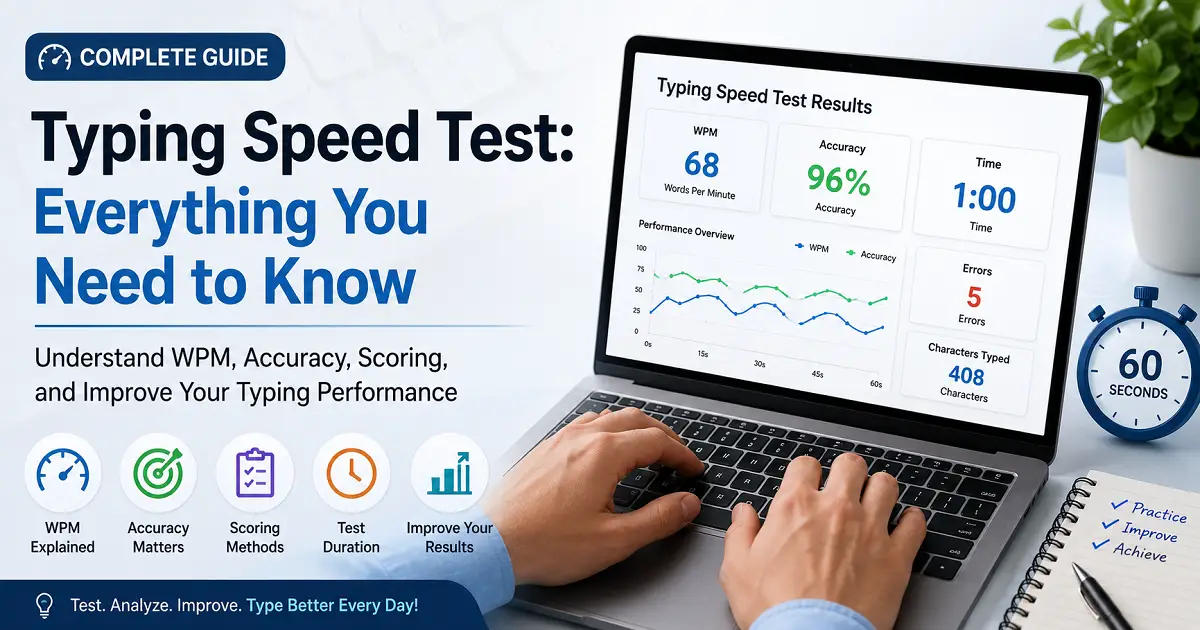
WPM stands for Words Per Minute. To ensure consistency across platforms, a standard word is defined as five characters (including letters, spaces, numbers, and punctuation).
How Typing Speed Is Calculated
The basic formula is: Total Characters Typed ÷ 5 ÷ Time in Minutes. Gross WPM calculates raw keystrokes, whereas Net WPM deducts errors to show real productivity.
How Typing Accuracy Is Measured
The accuracy formula is: (Correct Characters ÷ Total Characters Typed) × 100. Learn how to maintain high accuracy without sacrificing rhythm in our Complete Typing Accuracy Guide.
Different Types of Typing Tests
Tests range from isolated word-based drills to full paragraph simulations with realistic punctuation, numbers, and technical symbols.
1 Minute vs 3 Minute vs 5 Minute Tests
- 1 Minute: Quick baseline check.
- 3 Minutes: Balanced evaluation of speed and rhythm.
- 5 Minutes: Comprehensive test measuring sustained focus and stamina.
What Is a Good Typing Speed?
An average typist scores between 40 and 60 WPM. To see detailed benchmark tables categorized by age and job role, check our Typing Speed Benchmarks Guide.
Common Mistakes During Typing Tests
Rushing, backspacing excessively, and looking down at the keyboard drastically lower test performance. Explore solutions in our Common Typing Mistakes & Error Fixes Guide.
How to Improve Your Typing Test Score
The single most effective long-term strategy is adopting touch typing. Master finger placement and home-row rules with our Complete Beginner's Guide to Touch Typing and implement routines from our Guide to Increasing Typing Speed.
Benefits of Regular Typing Tests
Testing weekly helps track progress, improves focus, builds muscle memory, and reduces test anxiety under time limits.
Typing Speed Requirements for Jobs
Data entry operators typically need 60–80 WPM with 99% accuracy, while general office workers need around 50 WPM.
How TypeNest Helps You Improve
TypeNest provides structured drills, instant WPM tracking, error analysis, and customizable practice modules tailored to every skill level.
Conclusion
Regular typing tests provide the metrics you need to refine your mechanical speed and accuracy. Focus on steady daily practice, and your WPM will steadily climb over time.
Continue Learning
Deepen your keyboard mastery with these detailed resources on TypeNest:
- Complete Beginner's Guide to Touch Typing
- Complete Guide to Increase Typing Speed
- Complete Typing Accuracy Guide
- Typing Speed Benchmarks by Age & Profession
- WPM Requirements for Remote Jobs
- Common Typing Mistakes & Fixes
Last Updated: September 2026
Author: TypeNest Editorial Team