Table of Contents
Compare layout logic, character placement, and exam viability.
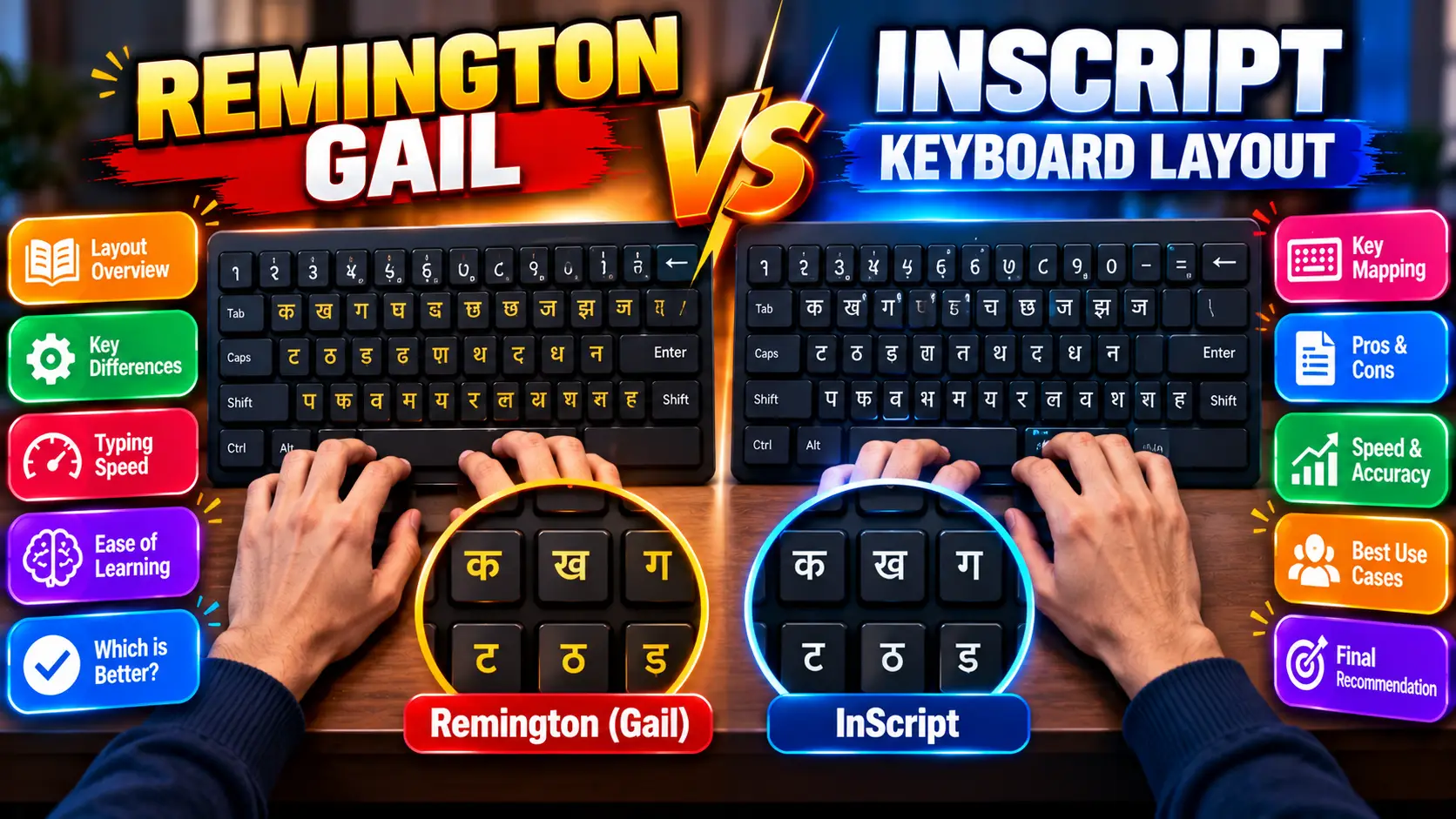
When preparing for regional Devanagari typing examinations in India—such as Marathi GCC-TBC 30 WPM, District Court Clerk recruitment, or Central SSC skill tests—candidates face a critical initial choice: Remington GAIL or Inscript? Selecting the wrong keyboard system can mean months of wasted muscle memory or disqualification if your chosen input layout is unsupported in your test hall.
Much like the ergonomic debates between alternative English arrangements explored in our QWERTY vs. Dvorak vs. Colemak Analysis, Devanagari input methods reflect two competing philosophies: adapting manual mechanical habits versus adopting a standardized linguistic architecture. In this comprehensive comparison, we break down how both layouts operate, their respective learning curves, and which standard provides the greatest long-term career advantage.
01. Origins: Typewriter Legacy vs. Linguistic Design
To understand why these two layouts exist side by side, we must examine their development history:
Legacy Remington GAIL (Typewriter Emulation)
Originating in the mechanical typewriter era, the Remington arrangement was engineered around physical mechanical levers. When computer word processing arrived, legacy typists who already possessed muscle memory on physical Godrej or Remington typewriters resisted relearning. The "Remington GAIL" layout was standardized by the Gas Authority of India Limited (GAIL) to map those traditional typewriter key assignments into modern Unicode input methods (using Mangal and similar fonts).
Standard Inscript (Indian Script National Standard)
Developed in 1986 by the Department of Electronics and CDAC (Centre for Development of Advanced Computing), Inscript was designed specifically for digital computers. Rather than replicating typewriter mechanical levers, linguists designed Inscript around the phonetic structure of Indian alphabets. It is built natively into every operating system (Windows, Linux, macOS, Android, and iOS) without requiring third-party software or driver installations.
02. Architectural Differences & Logic
The philosophical divide between the two systems determines how intuitively your brain maps keystrokes:
Inscript: Phonetic Bipartite Symmetry
Inscript divides the physical keyboard cleanly into two anatomical domains based on Sanskrit and Devanagari phonetics:
- Left Hand (Vowels / स्वर / मात्रा): All independent vowels and dependent matras are concentrated on the left side of the keyboard (e.g.,
ा, ि, ी, ु, ू, े, ै, ो, ौ). - Right Hand (Consonants / व्यंजने): All consonants are positioned on the right hand side, structured according to phonetic groupings (vargas: क-वर्ग, च-वर्ग, ट-वर्ग, त-वर्ग, प-वर्ग).
- Shift Symmetry: Striking a consonant without Shift gives the unaspirated sound (e.g.,
क), while holding Shift with the identical finger strikes its aspirated counterpart (e.g.,ख).
Remington GAIL: Arbitrary Mechanical Scattering
Because Remington evolved from mechanical typewriters, characters were placed to prevent physical typebars from clashing rather than for linguistic elegance:
- Vowels and consonants are scattered across both hands without logical phonetic grouping.
- Half-characters (अर्धे अक्षरे) often require distinct dedicated keystrokes or complex Alt-code sequences.
- Learning Remington requires memorizing key placements through sheer rote repetition rather than predictable phonetic patterns.
03. Typing Conjuncts (जोडाक्षरे) & Halant Execution
As detailed in our dedicated guide on Marathi Typing in GCC-TBC: Inscript vs. Kruti Dev, the speed at which you execute complex conjuncts (जोडाक्षरे) determines whether you pass or fail state exams.
Example: Typing the Conjunct "प्र" (Pra) & "क्त" (Kta)
Universal Pure Logic (Consonant + Halant + Consonant):
क + ् + त = क्त
Key sequence: k + d + l
Zero Alt-codes required. The rendering engine constructs the conjunct automatically.
Typewriter Style Combinations:
Requires half-letter keys or specific modifier combinations
Certain rare characters or traditional ligatures (e.g., क्र, त्र, ज्ञ, ष्ट्र) require memorizing specialized multi-key combinations or numeric ASCII codes.
04. Head-to-Head Comparison Table
This matrix evaluates both layouts across operational criteria relevant to competitive exam candidates:
| Criterion | Inscript Keyboard | Remington GAIL |
|---|---|---|
| Government Recognition | Official National Standard (Mandatory in most exams) | Accepted as an alternate option in specific state boards |
| System Availability | Built into all OS platforms natively | Requires Indic IME / specialized language pack setup |
| Learning Curve | Moderate (10–14 days) due to phonetic logic | High for beginners; easy only for legacy typewriter users |
| Multi-Language Transferability | Universal across all 12+ Indian scripts (Hindi, Marathi, Gujarati, etc.) | Limited solely to Devanagari (Hindi/Marathi) |
| Peak Speed Potential | 55–70 WPM comfortably with high accuracy | 45–60 WPM (frequent alt-codes can cause speed plateaus) |
| Future Proofing | 100% Future-Proof (Digital India standard) | Gradually being phased out by recruitment agencies |
05. Which Layout Should You Choose?
The answer depends entirely on your current keyboard background:
Scenario A: If you are an absolute beginner or currently type in English QWERTY
Choose Inscript without hesitation. Its left-hand vowel and right-hand consonant architecture complements English typing mechanics. Learning Inscript from scratch takes roughly 15 days of 45-minute daily practice, and it is universally supported across every state examination portal in India.
Scenario B: If you already possess 30+ WPM on manual typewriters or Kruti Dev
If you have an upcoming examination within the next 3 to 4 weeks and already type at passing speed using Remington GAIL, stick with your existing muscle memory for the immediate test—provided the recruitment notification explicitly allows Remington GAIL input. However, for long-term career flexibility, begin transitioning to Inscript as soon as your current exam cycle concludes.
Conclusion
While Remington GAIL served as a vital transitional bridge from mechanical typewriters to early desktop PCs, Inscript is the undisputed modern standard for Devanagari keyboarding. Its phonetic logic, zero dependence on third-party drivers, and universal government acceptance make it the superior choice for any candidate seeking long-term success in state clerical recruitments.
Begin calibrating your regional touch typing muscle memory and tracking accuracy metrics today on TypeNest Academy.
Last Updated: October 2026
Author: TypeNest Editorial Team