Table of Contents
Master the mathematical relationship between keystrokes and words.
When browsing official recruitment notices for Data Entry Operators, Tax Assistants, Postal Assistants, or High Court Clerks, candidates frequently encounter two competing metrics for keyboard proficiency: Words Per Minute (WPM) and Key Depressions Per Hour (KDPH / KPH).
A notification might state: "Candidate must possess a data entry speed of not less than 8,000 Key Depressions Per Hour." This leaves many aspirants puzzled: Does 8,000 KDPH mean 20 WPM, 30 WPM, or 50 WPM? How many characters must be struck during a 15-minute exam session? As detailed in our comprehensive breakdown of SSC CGL & CHSL DEST Typing Tests and our technical guide on How WPM and Accuracy Are Calculated, understanding this mathematical conversion is essential to pacing your preparation correctly.
01. What is KDPH / KPH?
KDPH (Key Depressions Per Hour), often interchangeably called KPH (Keystrokes Per Hour), is an absolute count of individual physical downward key actions executed within a theoretical one-hour window.
While commercial typing platforms measure speed in "Words", words in the English language vary dramatically in length (e.g., compare the two-letter word "to" with the thirteen-letter word "qualification"). In data entry, accounting, and government clerical testing—as highlighted in our Data Entry Operator Typing Secrets—testing agencies prefer KDPH because it measures raw mechanical work output regardless of vocabulary variance.
02. The Universal Mathematical Formula
Across all international and Indian government examination boards, the standardized statistical convention dictates that:
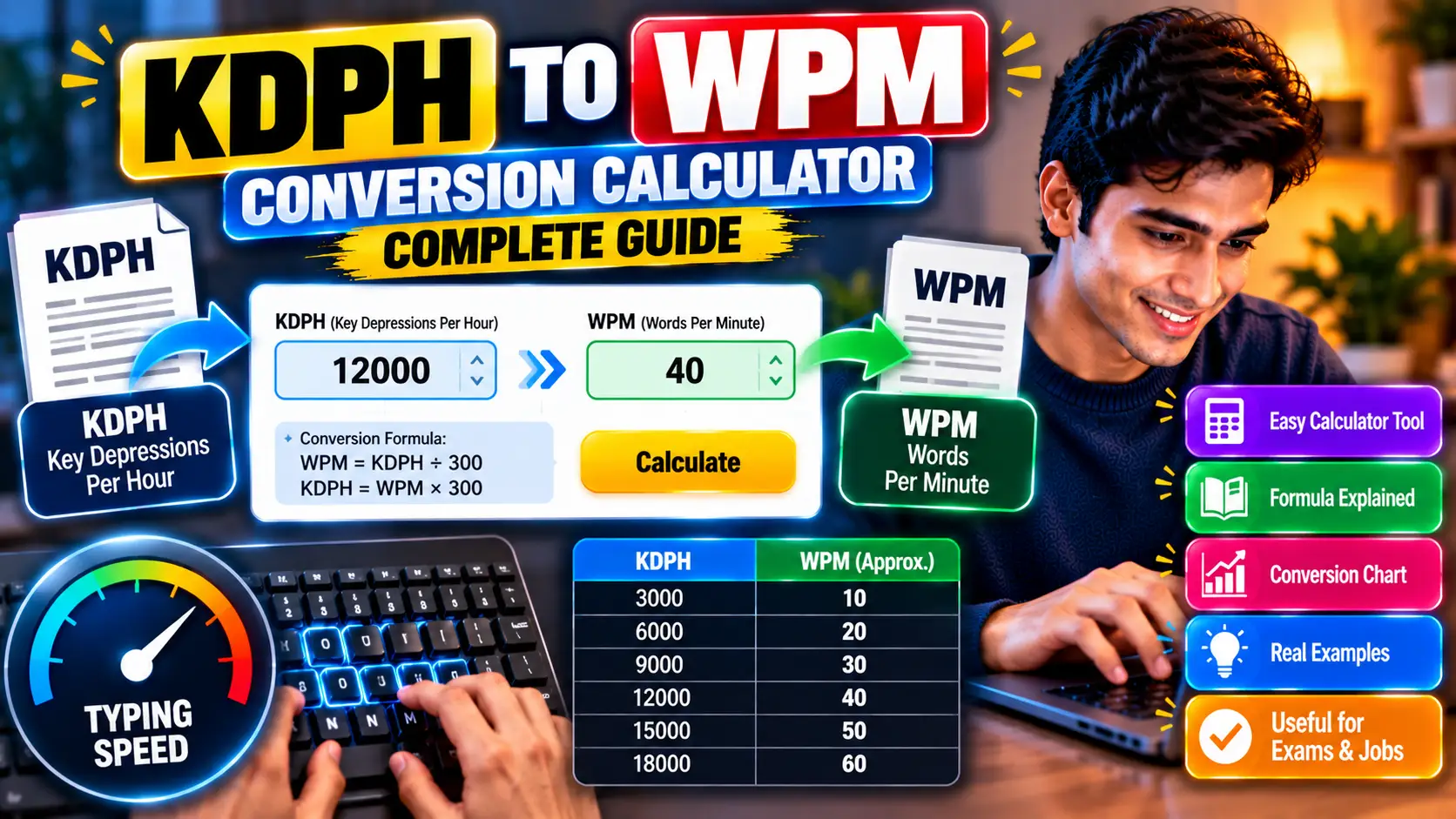
To convert between hourly key depressions and minute-based word rates:
03. Master Conversion Matrix (KDPH ↔ WPM)
This reference table translates common recruitment benchmarks into actionable practice targets:
| KDPH (Hourly) | WPM Equivalent | 15-Min Test Target | 10-Min Test Target | Typical Examination Application |
|---|---|---|---|---|
| 8,000 KDPH | 26.67 WPM (~27) | 2,000 Keystrokes | 1,333 Keystrokes | SSC CGL Data Entry (DEST), Tax Assistant |
| 9,000 KDPH | 30.00 WPM | 2,250 Keystrokes | 1,500 Keystrokes | GCC-TBC Marathi 30, State Lower Clerk |
| 10,500 KDPH | 35.00 WPM | 2,625 Keystrokes | 1,750 Keystrokes | SSC CHSL Postal Assistant / LDC English |
| 12,000 KDPH | 40.00 WPM | 3,000 Keystrokes | 2,000 Keystrokes | GCC-TBC English 40, High Court Typist |
| 15,000 KDPH | 50.00 WPM | 3,750 Keystrokes | 2,500 Keystrokes | Senior DEO, Commercial Transcriptionist |
04. SSC CGL / CHSL DEST Exact Benchmarks
In the Staff Selection Commission (SSC) combined graduate and higher secondary examinations, the DEST is conducted for exactly 15 minutes:
SSC CGL Standard 2,000 Key Depressions in 15 Minutes
Candidates must transcribe a printed or on-screen master passage of approximately 2,000 keystrokes. 2,000 / 15 minutes = 133.33 strokes per minute ÷ 5 = 26.67 WPM. While 27 WPM qualifies on paper, candidates must aim for 35 WPM during practice to safely absorb mistake penalties and software navigation friction.
SSC CHSL Standard 10,500 KDPH for DEO Grade 'A' / 35 WPM English
The higher tier requires 1,750 keystrokes in 10 minutes (equivalent to 35 WPM in English) or 1,500 keystrokes in 10 minutes (30 WPM in Hindi).
05. Do Spaces and Shift Strokes Count as Key Depressions?
Candidates routinely ask how individual non-alphabetic keystrokes are registered by examination scoring algorithms:
- Spacebar: YES. Every single space between words counts as a valid key depression. However, hitting double spaces where only one is required is penalized as an error.
- Punctuation & Numbers: YES. Periods, commas, hyphens, and numeric digits each count as one key depression.
- Shift Key: NO. Holding Shift while pressing
Ato produce capital A counts as one depression (for the character), not two. The modifier key itself is not credited as an independent stroke. - Backspace & Navigation: NO. Backspace strokes, Delete keys, and arrow navigation do not count toward your qualifying quota.
To ensure your qualifying scores satisfy evaluation boards, review the official full versus half mistake criteria analyzed in our Government Typing Test Guide.
Conclusion
Converting KDPH to WPM is straightforward once you know the core formula: simply divide the hourly requirement by 300. An 8,000 KDPH test demands an approachable 27 WPM, while 12,000 KDPH requires a firm 40 WPM. By targeting a 20% speed buffer during your daily practice, you ensure that test-day nerves and exam hall keyboards never prevent you from passing.
Track your live keystrokes, practice with official 15-minute exam passages, and calculate your net WPM on TypeNest Academy.
Last Updated: October 2026
Author: TypeNest Editorial Team