Table of Contents
Cognitive mechanics of visual lookahead and chunking.
Have you ever watched an elite typist clocking over 120 words per minute and wondered why their strokes sound like a smooth, uninterrupted purr rather than an erratic series of mechanical bursts? When average typists hit a speed wall around 50 to 60 WPM, they assume their fingers are physically incapable of moving faster.
In reality, finger velocity is rarely the true limitation. The bottleneck lives in the visual-cognitive pipeline. As explained in our breakdown on The Psychology of Typing: Training Your Brain, typing speed is dictated by how efficiently your visual cortex feeds incoming characters into your motor cortex. By mastering the Lookahead Technique, you eliminate the micro-pauses between words and effortlessly unlock an immediate 15 to 25 WPM speed surge.
01. What is the Lookahead Technique?
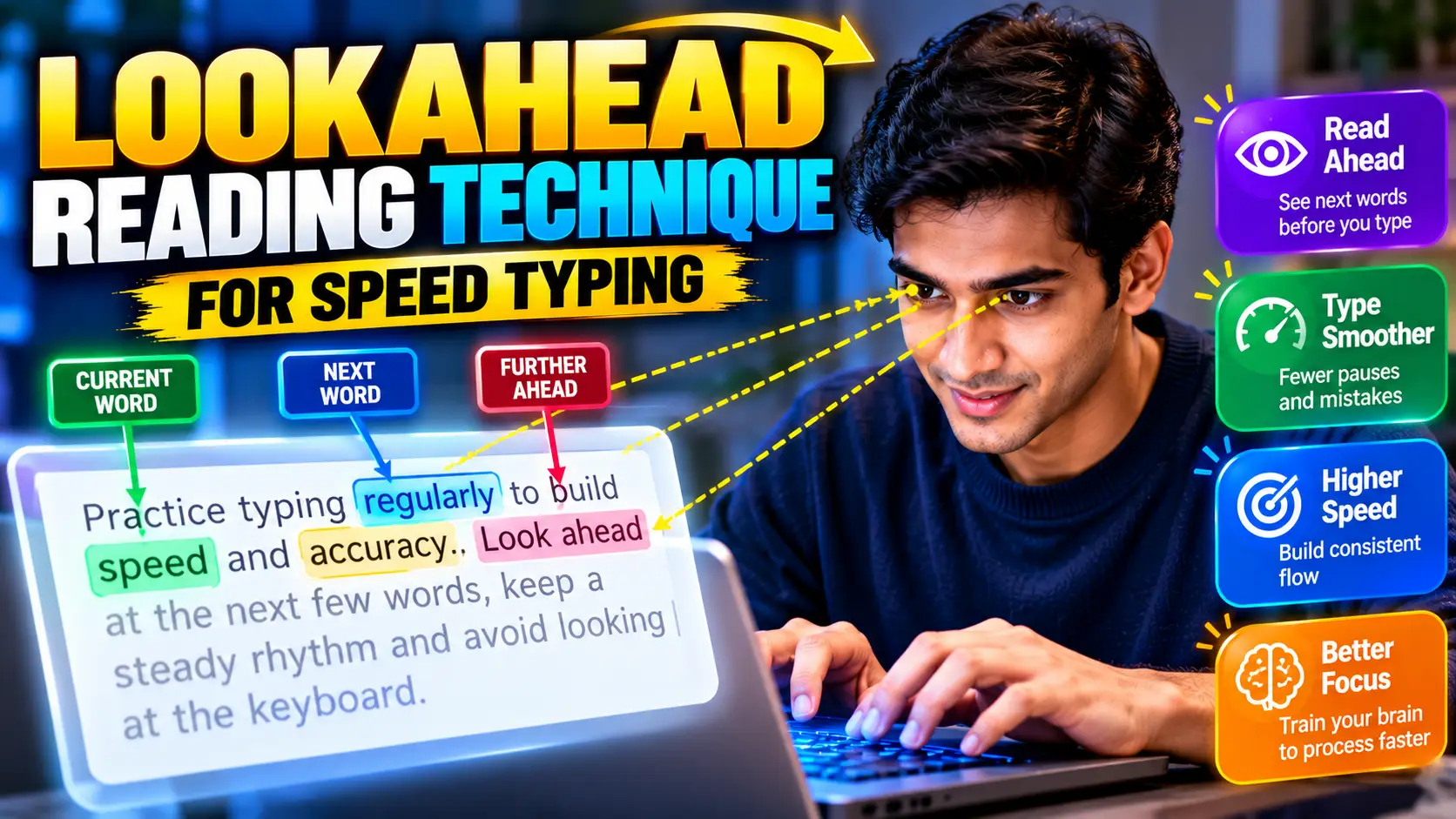
The lookahead technique is the practice of reading one to three words ahead of the exact character your fingers are currently striking. Instead of synchronizing your eyes with your fingertips, you create an asynchronous operational buffer:
While the fingers strike "speed", the subconscious motor program for "typing" is already queued, and the eyes are actively parsing the word "requires".
As we explored in How to Hit 120+ WPM: The Advanced Speed Blueprint, high-speed transcription requires decoupling sensory input from motor execution. If your eyes only read the letter currently being typed, every spacebar strike acts as a cognitive roadblock while your brain searches for the next word.
02. Letter-by-Letter Processing vs. Word Chunking
Beginning and intermediate typists process text serially. They look at the word "because", mentally break it down into b-e-c-a-u-s-e, confirm each letter on screen, and only then search for the next word.
Advanced typists engage in Lexical Chunking. Rather than individual keystrokes, the brain processes the entire word as a single motor pattern (an n-gram muscle reflex). While that reflex is executing automatically on autopilot, the typist's cognitive bandwidth is completely free to read the upcoming sentence.
| Metric / Behavior | Letter-by-Letter Typist (40–55 WPM) | Lookahead Typist (85–120+ WPM) |
|---|---|---|
| Visual Focus | Locked on current caret cursor | 1 to 3 words ahead of cursor |
| Spacebar Latency | 150–250ms pause after every word | < 30ms seamless cadence transition |
| Reaction to Long Words | Immediate deceleration and stutter | Pre-buffered; fingers strike rhythmically |
| Typing Rhythm | Staccato, burst-and-stop | Unbroken metronomic purr |
03. The 3-Word Cognitive Buffer
Attempting to read an entire paragraph ahead is counterproductive; the human short-term working memory cannot retain dozens of arbitrary keystrokes while executing intricate finger mechanics.
The sweet spot identified in cognitive keyboard research is a 3-Word Buffer:
- Word N (Active Execution): Managed by subconscious spinal motor reflexes without conscious intervention.
- Word N+1 (Motor Preparation): The brain primes the specific hand and finger movements required to initiate the first two letters of the upcoming word.
- Word N+2 (Visual Ingestion): The eyes parse word length, tricky letter n-grams, or potential punctuation hurdles.
This buffer absorbs speed fluctuations. If Word N contains an awkward reach (like minimum), your eyes are already preparing for the recovery word, preventing your tempo from collapsing.
04. Saccadic Eye Movement & Fixations
Human eyes do not glide smoothly along lines of text; they make rapid ballistic jumps called saccades, separated by brief stationary periods called fixations.
During a typing evaluation:
- Inexperienced typists make a fixation on every single word or syllable, jumping backward repeatedly (regressions) to ensure they didn't make a typo.
- Advanced typists make wide saccadic leaps, absorbing multi-word phrases in a single glance. They trust their tactile proprioception completely, as taught in our guide on How to Master Blind Typing Without Looking.
05. 3 Practical Drills to Build Your Buffer
If you are currently trapped on a Typing Speed Plateau at 55–65 WPM, perform these three exercises for 10 minutes daily:
Slow Down to Read Forward
Intentionally drop your practice speed by 30% on TypeNest Speed Tests. If you normally type at 60 WPM, force yourself to type at 40 WPM. Use the excess cognitive headroom to strictly lock your gaze two full words ahead of your fingers. Do not allow your eyes to glance at the word being struck.
Block the Active Caret
If you practice transcription from physical text or a split screen, place a small card or opaque window covering the exact word you are typing. This forces your brain to rely entirely on sensory memory while your visual focus stays projected forward.
Prime the Hand Before Spacebar
While typing the final two letters of any word, make it an unbreakable reflex to glance at the initial character of the following word. This enables your opposite hand to position itself above its home row key before the spacebar has even returned to its resting height.
Conclusion
Typing speed is not a race between your fingers; it is an optimization of your visual and cognitive supply chain. By letting go of visual feedback on active keys and intentionally projecting your gaze two to three words into the future, you eliminate pauses, stabilize accuracy, and easily break through persistent speed barriers.
Train your visual buffer and track your real-time cadence on TypeNest Academy.
Last Updated: October 2026
Author: TypeNest Editorial Team