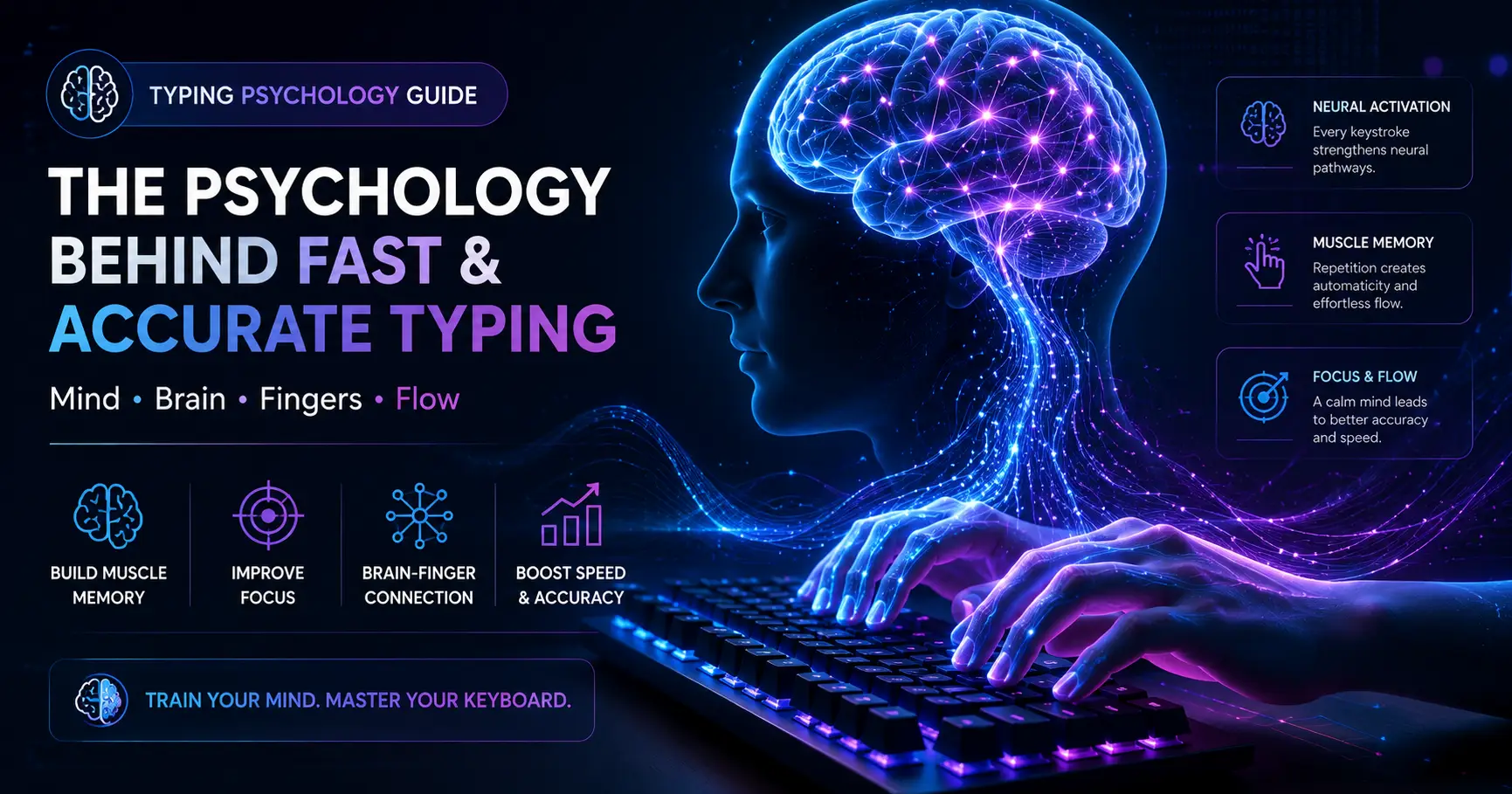
Have you ever wondered how master pianists play breathtaking compositions without ever looking at the keys, or how expert typists can carry on a conversation while churning out 90 words per minute? To the untrained eye, blind typing—or touch typing—looks like magic. However, it is rooted in fascinating neuroscience, cognitive psychology, and motor learning principles.
When you type without looking at the keyboard, you are not relying on visual feedback to guide your fingers. Instead, your brain taps into an intricate neural pathway built through repetitive physical movement, spatial orientation, and subconscious muscle memory. Understanding the psychological mechanics of blind typing transforms typing practice from a tedious task into a scientifically structured brain training process.
The Neuroscience of Blind Typing: How Your Brain Talks to Your Fingers
To understand blind typing, we must look inside the human brain—specifically at the Motor Cortex and the Cerebellum. Every physical action you perform, from reaching for a cup of coffee to pressing the letter 'K' on your keyboard, begins as an electrical signal in the motor cortex.
When a beginner attempts to type, the brain relies heavily on the visual cortex. The visual system searches for a letter on the physical keyboard, calculates the distance, sends a command down the central nervous system to the finger, and verifies whether the correct key was pressed. This visual feedback loop is extremely slow, mentally exhausting, and creates high cognitive friction.
When you transition to blind touch typing, your brain bypasses the visual cortex entirely. Instead, it relies on two crucial neurological systems:
- Proprioception: This is your brain’s internal GPS—the uncanny ability to sense the position and orientation of your limbs in space without looking at them. Proprioception allows you to touch your nose with your eyes closed, and it enables your fingers to locate the 'F' and 'J' home row bumps instantly.
- Procedural Memory: Housed within the basal ganglia and cerebellum, procedural memory stores automated physical skills. It is the same neurological storage mechanism responsible for riding a bike, swimming, or playing a musical instrument.
Psychology Insight: Blind typing shifts the mechanical task of key selection from conscious, visual brain regions to subconscious, motor-driven pathways. This frees up precious cognitive bandwidth for higher-level thinking and creative composition.
The Myth of "Muscle Memory"
We frequently hear typists say, "My muscles just know where to go." While this phrase is popular, muscles themselves have no memory! Muscles are purely mechanical actuators consisting of fibers that contract or relax based on signals sent by motor neurons.
What we casually call "muscle memory" is actually neuroplasticity in action within your Central Nervous System (CNS).
When you repeatedly practice moving your right index finger from the home row key J upward to U and downward to M, your brain fires a specific sequence of neurons. In the early stages, this neural pathway is faint and inefficient. However, through intentional repetition, your brain wraps these neural axons in a fatty insulating substance called Myelin.
Myelination speeds up electrical nerve impulses drastically—increasing signal transmission speed up to 100 times. When a motor pattern becomes fully myelinated, the movement transitions from deliberate thought to an automatic motor program stored in the cerebellum.
Cognitive Load Theory: Why Looking at the Keyboard Drains Your Energy
Developed by educational psychologist John Sweller in the late 1980s, Cognitive Load Theory explains how our working memory processes information. The human brain has a strictly limited capacity for holding conscious thoughts simultaneously.
When you hunt and peck on a keyboard, your cognitive processing is divided into three competing tasks:
- Intrinsic Load: Formulating thoughts, analyzing logic, structuring sentences, or solving problems.
- Extrinsic Load: Physical effort spent moving your neck down, scanning physical key caps, moving your neck back up, and visually auditing the monitor screen for mistakes.
- Germane Load: Synthesizing new information and storing long-term knowledge.
A hunt-and-peck typist wastes up to 60% of their conscious mental bandwidth purely on extrinsic cognitive load. By contrast, a blind typist reduces extrinsic load close to zero. Because key presses happen at a subconscious level, 100% of conscious brainpower remains focused on sentence structure, logical reasoning, and creative thought.
🧠 Brain Fact: The Subconscious Advantage
The human conscious mind can process approximately 40 to 50 bits of information per second. The subconscious mind, however, processes over 11 million bits per second. Blind typing hands over physical motor execution to the subconscious mind, unlocking unmatched mental speed and fluid focus!
Proprioceptive Calibration: The Science of Home Row Bump Sensitivity
If you examine a standard QWERTY or DVORAK keyboard, you will notice raised tactile bumps on the F and J keys. These tiny tactile ridges serve as critical proprioceptive anchors for your brain.
When your index fingers lightly rest on F and J, mechanoreceptors in your fingertips send instant sensory signals to the somatosensory cortex in your brain. This sensory confirmation establishes a zero-coordinate reference point. From this anchor, your brain calculates microscopic angular distances for every other key on the board:
- Moving the left ring finger up 15 degrees to hit
W. - Extending the right pinky finger sideways to reach
Semicolon (;)orEnter. - Dropping the left index finger downward to touch
VorB.
If a typist breaks visual dependency but fails to utilize tactile home row anchors, error rates skyrocket. True blind typing depends entirely on returning to these proprioceptive anchors continuously during continuous text input.
The Psychology of Error Prevention: Visual vs. Haptic Feedback
Why do amateur typists make repetitive errors? The primary culprit is a delay in sensory feedback loops.
When a hunt-and-peck typist makes an error, they usually do not realize it until they raise their head, look at the screen, visually recognize a misspelling, press backspace multiple times, look back down at the keys, re-orient their fingers, and re-type the word. This disrupted feedback loop takes 3 to 5 seconds per mistake and completely destroys mental momentum.
In contrast, a trained blind typist experiences **Haptic Error Detection**. Because their nervous system has precise expectations for key travel distance and tactile resistance, their motor cortex realizes a key was struck incorrectly milliseconds before the character even renders on the monitor!
This immediate subconscious feedback allows the typist to tap backspace automatically, correct the keystroke, and continue typing without breaking creative rhythm or visual gaze from their mental work.
Retraining Your Brain: Overcoming Bad Muscle Memory
One of the biggest mental hurdles in touch typing is unlearning bad habits. Many self-taught typists develop a modified hunt-and-peck technique using only three or four fingers. While they may achieve moderate speeds of 40 to 50 WPM, they hit a hard plateau because their brain's motor maps are inefficiently wired.
Neuroscientists call the process of rewiring these motor maps Cortical Remapping. When you decide to switch from a bad typing habit to true blind touch typing, your brain experiences temporary cognitive resistance. Your speed will temporarily drop before it skyrockets. Understanding the psychological phases of this transition helps you stay motivated through the friction.
| Phase | Cognitive State | Mental Experience & Brain Activity |
|---|---|---|
| 1. Unconscious Incompetence | Bad Typing Habits | You type with 2-4 fingers, looking down constantly. You are unaware of how much cognitive fatigue it causes. |
| 2. Conscious Incompetence | Frustration & Re-learning | You force yourself NOT to look down. Typing feels slow and awkward. Your brain is actively building new neural pathways. |
| 3. Conscious Competence | Deliberate Focus | You can blind type using all ten fingers, but it requires active mental concentration and deliberate finger movement. |
| 4. Unconscious Competence | Mastery & Flow State | Key presses become completely automatic. Your fingers move at the speed of thought while your mind focuses 100% on logic. |
The Role of Focus and Mindset in Blind Typing
Psychological state directly impacts muscle memory consolidation and motor performance. Attempting to master blind typing while stressed, distracted, or overly focused on raw speed actually slows down neural adaptation.
1. The Speed Trap vs. Accuracy First
The most common psychological mistake is rushing for high WPM (Words Per Minute) at the expense of accuracy. When you force your fingers to move faster than your brain can accurately map spatial coordinates, you introduce noise into your procedural memory.
Every time you make a typo and press the wrong key, your brain reinforces a flawed neural path. To build unbreakable muscle memory, you must slow down and aim for 98% to 100% accuracy. Speed is simply a natural byproduct of automated accuracy.
2. Deliberate Practice and Neuroplasticity
Mindlessly typing long paragraphs for hours will not rapidly improve your skills. According to psychologist Anders Ericsson, real mastery comes from Deliberate Practice—short, intense, and hyper-focused practice sessions aimed at specific weaknesses.
- Isolate Problem Keys: If your left pinky hesitates on
Q,Z, orShift, run 5-minute dedicated drills focusing exclusively on those fingers. - Rhythm and Cadence: Practice typing with a steady, metronome-like rhythm rather than bursting quickly and pausing frequently. A smooth cadence trains your nervous system to predict key distances effortlessly.
- Short, Daily Frequency: Practice for 15 to 20 minutes daily rather than a single 2-hour marathon on weekends. Frequent sleep cycles allow the brain to consolidate motor memory in the basal ganglia overnight.
5 Psychological Brain Tricks to Master Blind Typing Faster
To accelerate your brain's adaptation to touch typing, you can leverage proven cognitive tricks that train your nervous system faster:
1. Blindfold Strategy (Covering Your Hands)
If temptation forces you to glance at the keys, physically block your vision. Place a lightweight cloth over your hands or use a blank, legendless mechanical keyboard. When your visual cortex realizes no information is available, your brain instantly switches reliance to tactile and proprioceptive senses.
2. Vocalizing Keystrokes (Audio-Motor Coupling)
When struggling with difficult key combinations or special symbols, speak the letter aloud or mentally whisper it as your finger strikes the key. Linking auditory input with tactile touch reinforces neural pathways, doubling motor learning retention.
3. Visualization and Mental Rehearsal
Neuroscience shows that mentally visualizing a physical action activates the same motor cortex pathways as physically performing it. Before sleeping or during rest breaks, mentally picture your hands sitting on the home row and visualize your fingers moving smoothly to reach E, R, T, and symbol keys.
4. Mental Reset After Mistakes
When you make a typo, do not rapidly hammer the backspace key in frustration. Stop for half a second, mentally acknowledge the correct finger trajectory, press backspace smoothly, and type the entire word correctly from start to finish. This prevents your brain from storing frantic panic patterns in procedural memory.
5. Gamification and Instant Dopamine Loops
Training your brain requires positive reinforcement. Interactive platforms like TypeNest use real-time visual progress trackers, speed analytics, and achievement rewards to trigger dopamine release. Dopamine enhances synaptic plasticity, making learning faster and far more enjoyable.
Conclusion: Transforming Typing into an Extension of Thought
Blind typing is far more than a practical office skill—it is an art of cognitive liberation. By training your brain, respecting the mechanics of neuroplasticity, and trusting your subconscious muscle memory, you remove the physical wall between your mind and the digital screen.
Once you master the psychology of touch typing, typing stops being a conscious chore. Your ideas, code, stories, and thoughts flow directly from your mind onto the page at the speed of thought.
Continue Learning
Training your brain for blind typing is a cognitive process that combines muscle memory, spatial awareness, and deep mental focus. Explore these detailed guides to refine your touch typing technique, eliminate bad habits, and master typing ergonomics.
- Complete Beginner's Guide to Touch Typing
- Complete Typing Accuracy Guide
- Complete Guide to Increase Typing Speed
- Common Typing Mistakes and How to Fix Them
- Typing Ergonomics Guide: Healthy Habits for Long Sessions
- Mechanical vs. Membrane Keyboards for Speed & Tactile Feedback
Rewire Your Brain for Effortless Touch Typing with TypeNest
Building unbreakable muscle memory requires consistent, deliberate practice. TypeNest offers scientifically structured typing modules, targeted accuracy exercises, and real-time performance tracking designed to train your subconscious mind for blind typing.
Just 10 to 15 minutes of daily focused practice will strengthen your neural pathways, eliminate finger hesitation, and allow you to type as fast as you think. Start training your brain today and unlock seamless typing flow.
Last Updated: July 2026
Author: TypeNest Editorial Team