Table of Contents
Pacing methods for competitive and exam-oriented typists.
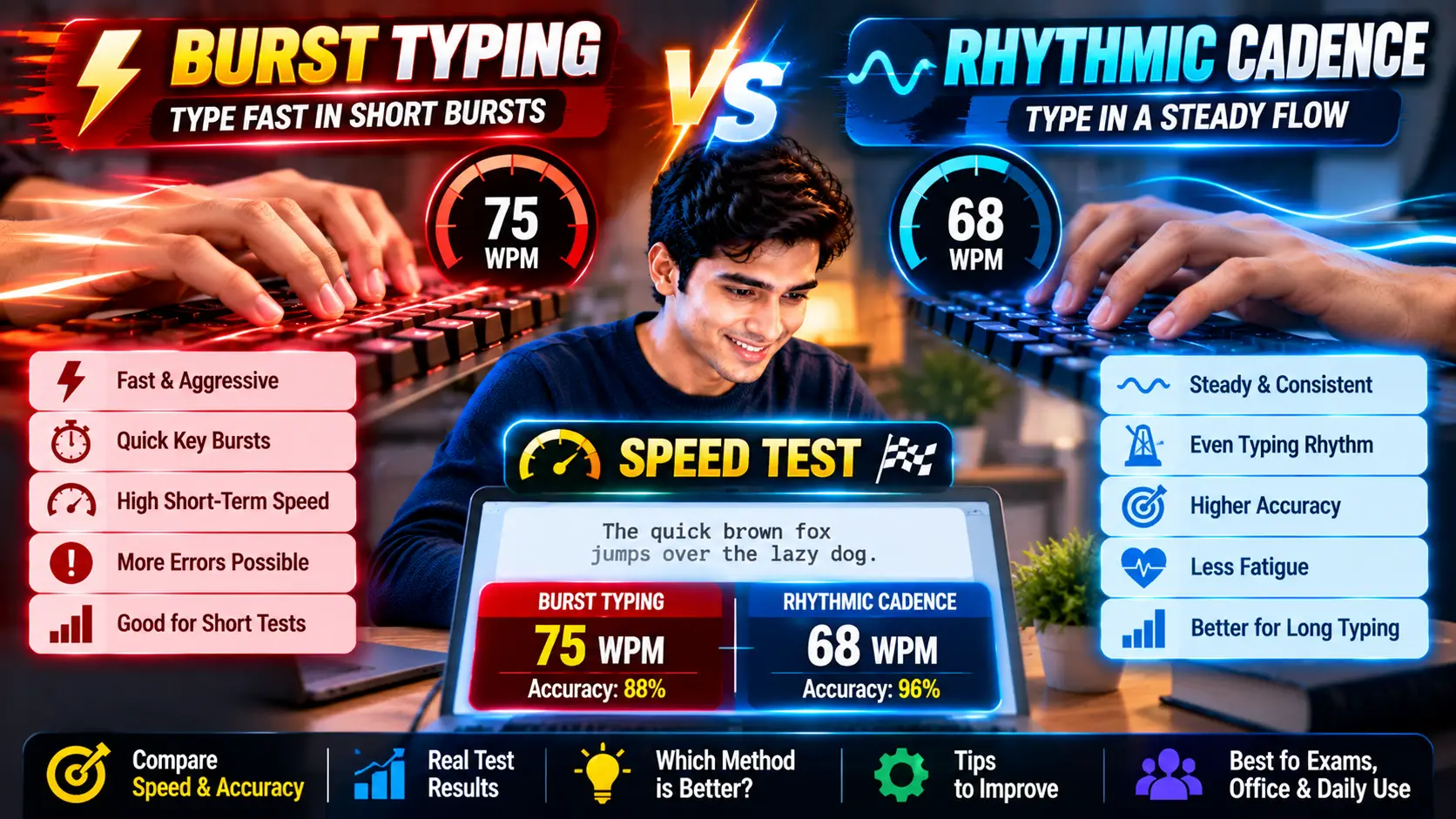
Listen to two different 80 WPM typists taking a speed test, and you will hear two completely distinct auditory signatures. The first typist sounds like a machine gun firing in uneven bursts—a rapid clatter on common words followed by noticeable hesitations on longer phrases. The second typist sounds like a clockwork metronome, striking every character at an identical tempo regardless of whether the word is "and" or "extraterrestrial".
Which of these approaches yields superior long-term velocity and accuracy? As typists progress past intermediate thresholds into the elite tiers covered in our 120+ WPM Advanced Speed Blueprint, the question of keyboard pacing becomes central. Understanding how burst speed interacts with rhythmic control is essential to overcoming the plateaus detailed in our guide on How to Overcome Typing Speed Plateaus.
01. Defining Burst Typing & Rhythmic Cadence
The two pacing philosophies represent fundamentally different strategies for managing cognitive processing and finger actuation:
Burst Typing (Variable Pacing)
The typist accelerates to maximum physiological velocity (often 120–140 WPM) on familiar words, high-frequency bigrams (th, er, on), and short words. On encountering difficult terms, numbers, or punctuation, speed decelerates sharply to prevent typos before bursting again.
Rhythmic Cadence (Metronomic Pacing)
The typist locks into a constant, uniform inter-keystroke interval (e.g., exactly 120 milliseconds per stroke). Words are typed at the identical deliberate cadence regardless of familiarity or complexity, prioritizing predictable motor rhythm and low cognitive variance.
02. Biomechanics of N-Gram Bursting
Burst typing relies on Motor Chording. When the human brain processes an exceedingly common sequence like "the", it does not send three distinct neurological commands (T → H → E). It discharges a single compound motor reflex where three fingers roll across the keycaps almost simultaneously.
This approach offers distinct advantages:
- Maximizes Easy Real Estate: English prose is heavily weighted toward top-100 words. Bursting allows you to bank speed on easy words to offset time spent on difficult vocabulary.
- High Peak Numbers: In short 15-second or 30-second benchmark sprints, burst typists consistently achieve the highest raw WPM numbers.
However, the vulnerability of pure burst typing lies in its inter-word collision risk. When you exit a 130 WPM sprint on "with" and hit a complex word like "phenomenon", the sudden deceleration often causes your fingers to overrun their motor cues, resulting in transposed characters.
03. The Endurance Value of Metronomic Cadence
Metronomic cadence is the preferred technique taught in classical stenography institutes and government clerical training centers.
By enforcing an unwavering beat:
- Cognitive Calm: The brain avoids erratic adrenaline spikes. The typist's heart rate stays steady, preventing the panic-tremor loop explored in our guide on Overcoming Typing Test Anxiety.
- Flawless Lookahead Buffer: Because strokes land at predictable intervals, the visual system has time to scan ahead without losing track of current execution, reinforcing the Lookahead Reading Technique.
- Near-Zero Error Cascades: Because the typist never over-accelerates past their control envelope, accuracy consistently hovers between 98.5% and 100%.
04. Head-to-Head Comparison Matrix
This matrix evaluates both approaches across real-world testing scenarios:
| Performance Metric | Burst Typing Strategy | Rhythmic Cadence Strategy |
|---|---|---|
| Ideal Test Duration | 15s – 60s short sprints | 5 – 15 minute continuous exams |
| Accuracy Consistency | Erratic (92%–96%) | Superior (98.5%–100%) |
| Forearm Muscle Fatigue | High (Frequent tension spikes) | Low (Consistent aerobic exertion) |
| Net Speed Calculation | High Gross WPM, penalized by errors | Stable Net WPM under official rules |
| Exam Center Suitability | Risky on stiff lab keyboards | Optimal for high-stress certification |
As examined in our analysis of How WPM and Accuracy Are Calculated, standardized government scoring formulas subtract five words or multiple percentage points for every uncorrected error. In long assessments, a typist clocking a steady 55 Net WPM via rhythmic cadence will consistently outscore an erratic 75 Gross WPM burst typist who drops six typos.
05. The Hybrid Protocol: Elastic Cadence
The world's highest-ranking touch typists do not choose rigidly between pure bursting and strict metronome beats. They utilize an advanced synthesis termed Elastic Cadence:
The Elastic Cadence Protocol
- The 80% Baseline Anchor: Establish your metronomic cruising speed at 80% of your all-out sprint potential. If you can burst at 100 WPM, set your steady cruising rhythm at 80 WPM.
- Controlled Word-Level Bursts: When your visual lookahead registers an ultra-familiar 3-letter sequence (and, the, but, for), allow fingers to burst cleanly within the word boundary.
- The Spacebar Re-Anchor: Never burst across the spacebar into an unfamiliar word. Use the spacebar keystroke as a rhythmic reset, returning your hands to your 80% cruising tempo before initiating the next word.
Conclusion
Burst typing delivers exhilarating short-form speed, but rhythmic cadence builds the endurance, calm, and precision required to clear high-stakes certification tests. By grounding your baseline typing in a steady metronomic pulse while reserving bursts strictly for familiar word chords, you achieve the ideal balance of speed and control.
Calibrate your typing rhythm and measure your keystroke cadence stability today on TypeNest Academy.
Last Updated: October 2026
Author: TypeNest Editorial Team