Table of Contents
Explore typing standards across legal careers.
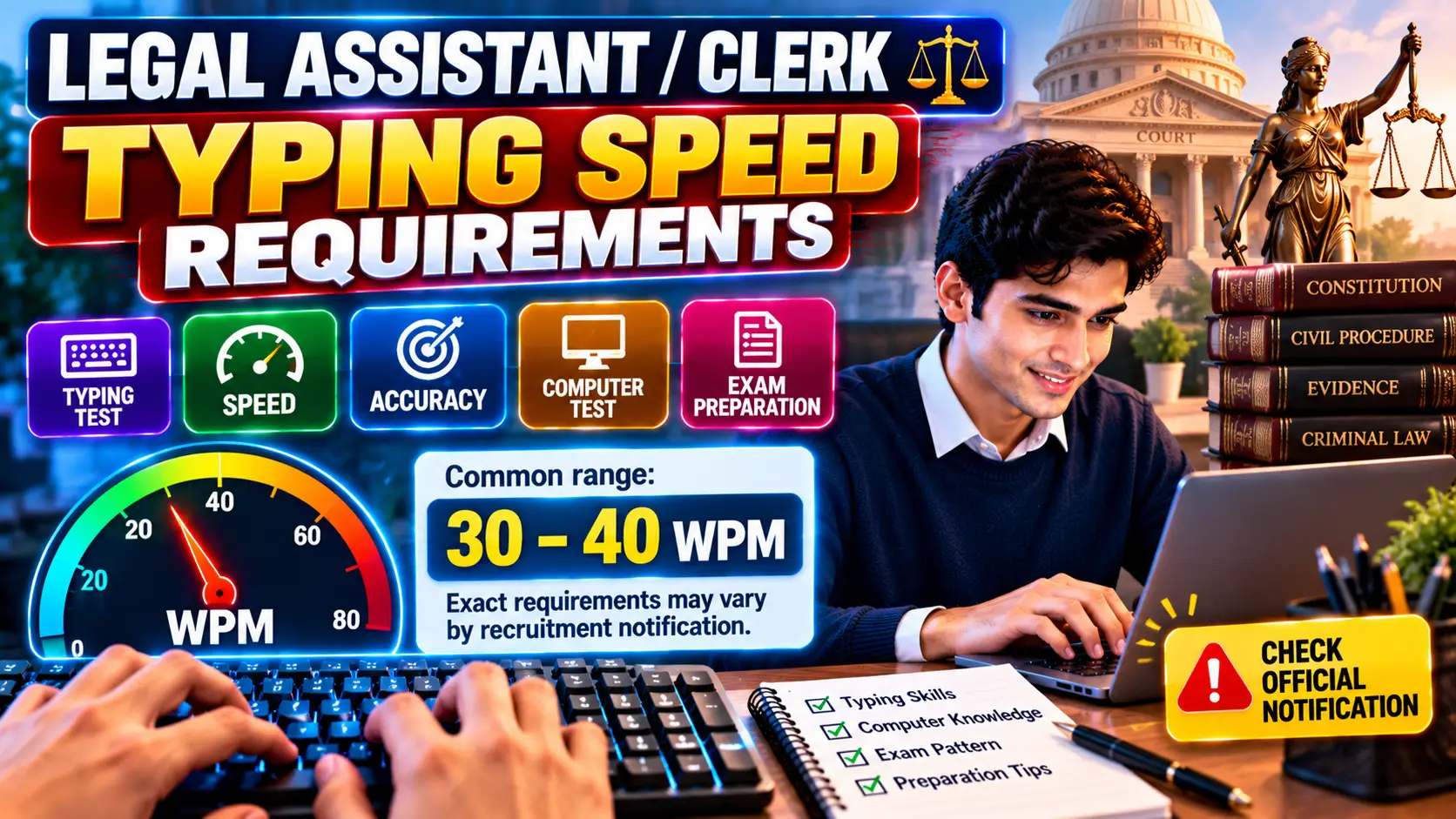
In the legal profession, time is literally billed in six-minute increments. Whether drafting urgent writ petitions, structuring commercial contracts, or compiling appellate records for filing before the registry closes at 4:30 PM, the speed and fidelity of documentation dictate a legal team's effectiveness.
While general administrative assistants typically qualify with 40 to 45 words per minute as detailed in our broader Typing Speed Benchmarks Guide, legal secretaries, litigation paralegals, and court clerks face substantially higher demands. Legal documents feature arcane Latin maxims, complex statutory section numbers, parenthetical case reporters, and rigid court formatting guidelines. Building on our examination of judicial standards in the Bombay High Court Clerk Typing Guide, this article explores the practical speed expectations and technical skills demanded by the legal industry.
01. The High Stakes of Legal Transcription
Legal drafting does not tolerate approximate spelling or relaxed typographical conventions. A single misplaced punctuation mark can alter the enforceability of a commercial clause or jeopardize a criminal appeal:
The Cost of Typographical Errors in Law
Confusing legal terms of art such as "indemnify" versus "identify", "reversion" versus "rescission", or omitting a single digit in a land survey plot number (Survey No. 48/B vs Survey No. 48/D) invalidates court filings and requires costly formal rectification motions.
Much like creative prose drafting analyzed in Typing Speed for Writers and Content Creators, lawyers and advocates rely on fast support staff to convert dictations, voice memos, and handwritten bench notes into formal pleadings before statutory limitation periods expire.
02. Official WPM Benchmarks by Role
Hiring partners, legal recruiters, and judicial service commissions categorize typing speed requirements according to role complexity:
| Job Designation | Entry Threshold | Competitive Target | Accuracy Floor | Core Document Workflows |
|---|---|---|---|---|
| Junior Legal Assistant / Clerk | 40–45 WPM | 50–55 WPM | 97.0% | Vakalatnamas, formal notices, affidavit copies |
| Litigation Paralegal | 55–60 WPM | 65–75 WPM | 98.5% | Pleadings, discovery summaries, appellate briefs |
| Executive Legal Secretary | 65–70 WPM | 75–85+ WPM | 99.0% | Live partner audio dictation, merger contracts |
| Judicial Registry Typist | 40 WPM (Mandatory) | 50+ WPM | 98.0% (Strict) | Daily court orders, certified decree copies |
03. Typing Citations, Sections & Exhibits
A major differentiator between casual administrative typists and legal transcriptionists is the ability to type specialized legal notation without looking down at the keyboard:
Case Law Reporters
Typists must enter alternating sequences of numbers, abbreviations, and parenthetical years without pausing:
                                (2024) 4 SCC 382 @ para 14

                                AIR 2021 SC 1405; 2018 (2) BomCR 512
Statutory Sections & Symbols
Constant execution of section marks, sub-clauses, and legal abbreviations using opposite-hand Shift discipline:
                                Section 138(1)(b) of the NI Act

                                Exhibit "P-1" r/w Order XXXIX Rules 1 & 2
To execute citation numbers and symbols fluidly without dropping your typing speed, review the opposite-hand modifier mechanics detailed in our guide on How to Type Punctuation and Symbols Faster.
04. Court Stenography vs. QWERTY Legal Assistants
A common point of confusion among candidates entering the legal sector is the distinction between court reporters and legal typists:
Court Reporters / Stenographers (200+ WPM)
As detailed in our in-depth comparison on Stenography vs. Touch Typing, official court reporters use 22-key chorded machines rather than standard QWERTY keyboards. They write in phonetic shorthand in real-time inside the courtroom during live testimony and oral arguments.
Legal Assistants & Paralegals (55–80 WPM)
Legal assistants operate on standard QWERTY computer keyboards. They do not record live spoken arguments in real-time; instead, they draft pleadings, format contracts, transcribe audio dictations, and prepare official case files inside office environments.
05. Deliberate Practice Plan for Legal Typists
To reach a competitive speed of 65+ WPM with 98.5%+ accuracy on legal matter, integrate this weekly practice split into your routine:
Latin Legal Terminology Drills (15 mins daily)
Transcribe core Latin terms until muscle memory executes them without pause: prima facie, habeas corpus, res judicata, inter alia, mutatis mutandis, certiorari, pro bono publico.
Judicial Cause Title & Memo Formatting (15 mins daily)
Practice typing party descriptions, petition numbers, and prayer clauses containing extensive uppercase titles, quotation marks, and bracketed legal abbreviations.
Strict 10-Minute Timed Mock Tests (20 mins daily)
Take timed legal passages on TypeNest Timed Tests, aiming for zero backspacing on case numbers, dates, and party names.
Conclusion
A career as a legal assistant or litigation clerk requires combining steady keyboard velocity with uncompromising attention to textual detail. By mastering the punctuation patterns of case law citations, conditioning your hands on statutory terminology, and maintaining calm focus under tight court filing deadlines, you establish yourself as an indispensable asset to any legal practice.
Test your speed on technical legal passages and track your real-time accuracy today on TypeNest Academy.
Last Updated: October 2026
Author: TypeNest Editorial Team