Table of Contents
Essential competencies for healthcare documentation specialists.
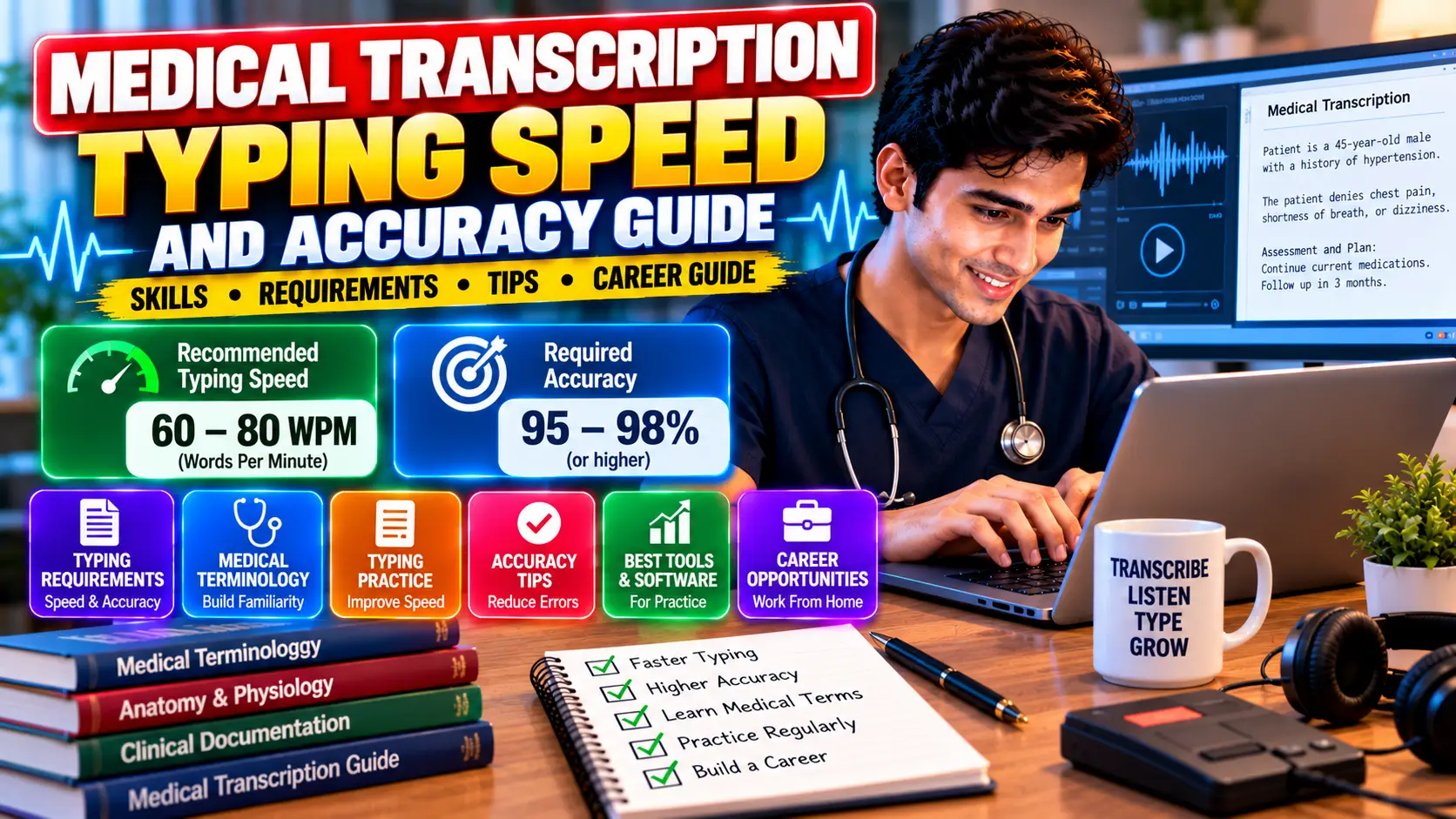
In general typing, a misplaced letter or punctuation error is an aesthetic blemish. In Medical Transcription (MT) and Healthcare Documentation, typing precision is quite literally a matter of life and death. Confusing "hyperthyroidism" with "hypothyroidism" or mistyping a dosage from 15 mg to 150 mg can trigger critical clinical consequences.
While remote data entry roles explored in our guide on Typing Speed Requirements for Remote Jobs prioritize broad volume, medical documentation demands zero-compromise precision combined with rapid sustained velocity. Building on the foundational mechanics from our Transcription & Subtitling Career Guide, this article explores how medical transcriptionists transcribe complex physician audio dictations into standardized Electronic Health Records (EHR).
01. Why Clinical Typing Differs from General Typing
Clinical transcription challenges the motor memory of standard QWERTY typists due to three specific factors:
Greco-Latin Lexicons
Medical words feature atypical character sequences (e.g., sphygmomanometer, choledocholithiasis) that disrupt standard English digram muscle memory.
High Numeric & Symbol Mix
Continuous transitions between text, decimal dosages, laboratory ratios, and blood pressure figures demand constant reach to the number row.
Rapid Dictation Cadence
Physicians dictate patient discharge summaries, operative reports, and pathology consults at speeds exceeding 140–180 words per minute.
02. Speed & Accuracy Standards (The 98.5%+ Rule)
Healthcare documentation agencies, hospital networks, and third-party transcription providers enforce strict quality audits:
| Metric | Entry-Level Trainee | Certified MT Specialist | Speech Recognition Editor |
|---|---|---|---|
| Gross Raw Typing Speed | 55–65 WPM | 75–90+ WPM | 60–75 WPM (Focused on editing) |
| Mandatory Accuracy Floor | 98.0% | 98.5% – 99.5% | 99.8% Critical Target |
| Line Production Quota | ~600 lines / 8-hr shift | 1,000–1,400 lines / day | 1,500+ lines / day |
As discussed in our Typing Accuracy Guide, attempting to accelerate raw keystrokes while tolerating a 95% accuracy rate is completely disqualifying in clinical evaluations. Maintaining uncompromised precision is the single most valuable skill in medical documentation.
03. Conquering Complex Pharmacology & Jargon
The primary impediment to maintaining a steady typing rhythm is unfamiliar multi-syllabic terminology. When a typist encounters words like "hydrochlorothiazide" or "electroencephalogram", motor processing stutters.
Professional medical transcriptionists overcome this using two specific methodologies:
Strategy 1 Morphological Root Chunking
Rather than processing terms letter-by-letter, train your hands on standard prefixes and suffixes: Prefixes: anti-, brady-, dys-, hyper-, hypo-, tachy- Suffixes: -ectomy, -itis, -ology, -scopy, -stomy When fingers recognize "cholecyst" and "ectomy" as two distinct automated motor patterns, typing cholecystectomy becomes as frictionless as typing football.
Strategy 2 Sound-Alike Drug Distinction (Look-Alike / Sound-Alike)
Pharmacological transcription requires vigilance regarding LASA (Look-Alike, Sound-Alike) medications. Typing Celebrex (anti-inflammatory) instead of Celexa (antidepressant), or Zantac instead of Xanax constitutes a critical medical error.
04. Hardware: Foot Pedals & Text Expander Software
How do medical transcriptionists maintain net outputs equivalent to 100+ WPM while listening to muffled audio? The answer lies in specialized peripheral hardware and text expansion engines:
- Three-Pedal USB Foot Controls: The typist's hands never leave the home row to operate audio playback. The center pedal plays audio, the left pedal rewinds by 3 seconds, and the right pedal fast-forwards. Keeping hands strictly on keyboard anchors maintains typing cadence without interruption.
- Text Expansion Macros (ShortKeys / AutoCorrect): Professional MTs never type full institutional phrases manually. Typing a short abbreviation triggers instant replacement:
;heent → Head, eyes, ears, nose, and throat normal, noncontributory.
;nlmed → The patient is currently taking no prescription medications.
;cvs → Heart sounds normal, regular rate and rhythm without murmurs. - Punctuation Agility: Rapid formatting of blood pressures (
120/80 mmHg) and lab parameters requires fluid pinky reach, as detailed in our guide on How to Master Punctuation and Symbols Faster.
05. Practical 4-Week Clinical Training Regimen
To prepare for healthcare transcription qualification examinations or medical scribe assessments, follow this targeted training progression:
Anatomical Root Drills
Practice 100 core medical prefixes, combining roots, and suffixes. Build muscle memory for Latin word stems until fingers no longer hesitate on multi-vowel clusters.
Pharmacology & Numeric Precision
Transcribe lists of the Top 200 generic and brand-name medications. Pair medication names with numeric dosage figures, decimal units (mg, mL, mcg), and frequency notations (b.i.d., t.i.d., q.d.).
Audio Dictation & Foot Pedal Sync
Integrate playback foot pedals. Practice audio transcription using varied accented dictations. Focus on audio buffering—listening 5 to 7 words ahead while typing current sentences.
Mock Clinical Audit Testing
Transcribe complex 10-minute operative notes and discharge consultations. Enforce strict 99% accuracy thresholds on TypeNest Speed Tests, penalizing critical medical typos heavily.
Conclusion
Medical transcription represents the highest standard of typing discipline. Velocity without precision is unacceptable in clinical workflows; true professionals build their reputation on uncompromising textual accuracy, rapid root-word recognition, and ergonomic keyboard mechanics.
Sharpen your technical typing accuracy, numeric agility, and sustained WPM endurance today on TypeNest Academy.
Last Updated: October 2026
Author: TypeNest Editorial Team