Why Every Website Needs a Domain Name
Every website you visit has something in common—it has an address that allows people to find it on the internet. Whether you're watching videos, reading articles, shopping online, or accessing your email, you reach those websites by entering or clicking on a domain name.
Without domain names, using the internet would be much more complicated. Instead of typing simple website addresses like google.com or typenest.in, you would have to remember long numerical IP addresses for every website you wanted to visit. While computers can easily understand numbers, people cannot remember thousands of them.
Domain names solve this problem by giving every website a unique and easy-to-remember identity. They act as friendly names that point visitors to the correct website, making the internet simple enough for anyone to use.
Whether you're launching a personal blog, a business website, an online portfolio, or an educational platform, choosing the right domain name is one of the first and most important decisions you'll make. It represents your website, strengthens your brand, and becomes the address people remember when they want to visit again.
In this guide, you'll learn what a domain name is, how it works, why it matters, how it connects to web hosting, and what beginners should know before registering their first domain.
What Exactly Is a Domain Name?
A domain name is the unique address people type into their web browser to visit a website. Instead of using complicated numbers, visitors simply enter a memorable name that points them to the correct server where the website is stored.
Some well-known examples include:
- google.com
- wikipedia.org
- github.com
- amazon.com
- typenest.in
Although these names appear simple, each one is connected to a powerful network of servers and internet infrastructure working behind the scenes.
You can think of a domain name as the digital equivalent of a street address. Just as people use your home address to find your house, internet users rely on domain names to locate websites anywhere in the world.
Why Domain Names Are So Important
Imagine trying to tell your friend to visit your website using a numerical address such as 142.250.193.78 instead of a simple domain name.
Most people would forget that number within seconds.
Now compare it with a name like typenest.in.
It's short, memorable, easy to pronounce, and much easier to share.
That's exactly why domain names exist. They make websites accessible not only for computers but also for ordinary people.
A good domain name also provides several long-term benefits.
- Creates a professional online identity.
- Helps visitors remember your website.
- Improves brand recognition.
- Makes sharing your website easier.
- Builds credibility and trust.
- Supports long-term business growth.
For businesses, content creators, and educational websites, a domain name often becomes one of the strongest parts of their online brand.
How Domain Names Make the Internet Easier
Computers communicate using IP addresses, which are long strings of numbers. While machines process these numbers efficiently, they aren't practical for humans.
Domain names provide a simple translation layer between people and computers.
Instead of remembering hundreds of numerical addresses, users only need to remember meaningful names.
This simple idea has made the internet dramatically easier to use and has allowed billions of people to access websites without needing any technical knowledge.
A Real-Life Example Anyone Can Understand
Imagine you want to visit a friend who lives in another city.
You don't memorize the exact GPS coordinates of the house. Instead, you simply use the home's address.
The postal service or navigation system uses that address to locate the exact destination.
Domain names work in almost the same way.
- Your domain name is the address.
- The internet finds the correct server.
- The website is delivered to your browser.
The visitor never needs to know where the server is physically located. The domain name handles that complexity automatically.
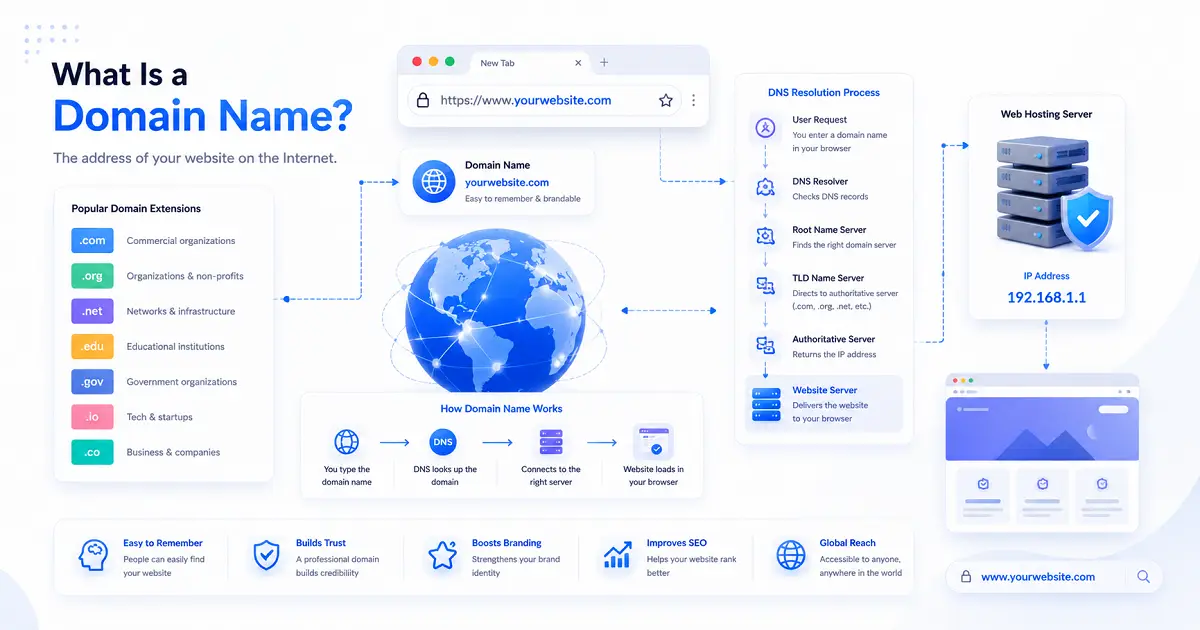
What Happens When You Type a Domain Name?
Although opening a website takes only a second or two, several important steps happen behind the scenes.
- You type a domain name into your browser.
- Your browser asks the Domain Name System (DNS) for the website's IP address.
- DNS returns the correct server address.
- Your browser connects to the hosting server.
- The server sends the website files back to your browser.
- Your browser displays the complete webpage.
This entire process usually finishes within a fraction of a second, giving users the impression that websites open instantly.
Domain Names and Web Hosting Work Together
Many beginners think that buying a domain name automatically creates a website.
In reality, a domain name and web hosting perform completely different jobs.
A domain name is simply the address visitors use to find your website.
Web hosting stores the actual website files that visitors see after entering that address.
Without hosting, a domain points to nothing. Without a domain, visitors have no easy way to reach your hosted website.
To understand this relationship in greater detail, read our guide on What Is Web Hosting? Everything Beginners Need to Know .
Every Modern Website Starts With Two Things
Before launching a website, most website owners complete two essential steps.
- Register a domain name.
- Purchase a hosting plan.
Once both are connected, the website becomes available to visitors around the world.
Of course, before publishing anything online, the website itself must first be designed and developed.
If you're new to website creation, our guide on Web Development Basics for Beginners explains how websites are built before they are connected to hosting and domain names.
In the next section, we'll explore DNS, IP addresses, different parts of a domain name, popular domain extensions, and how to choose a domain name that people can easily remember.
Understanding the Domain Name System (DNS)
A domain name would be useless if computers didn't know where that website was actually located. This is where the Domain Name System (DNS) becomes essential.
DNS works like a giant directory for the internet. Instead of expecting people to remember long numerical IP addresses, it translates easy-to-read domain names into the correct server addresses.
You can think of DNS as the internet's contact list. When you search for a person's name on your phone, your phone automatically finds the associated phone number. Similarly, DNS finds the correct IP address connected to a domain name.
This entire process happens automatically and usually takes only a fraction of a second, which is why most internet users never notice it happening.
What Is an IP Address?
Every device connected to the internet has a unique numerical identifier called an Internet Protocol (IP) address.
Servers that store websites also have IP addresses. Computers use these numbers to communicate with one another across the internet.
An IPv4 address usually looks something like this:
142.250.193.78
Although computers can process these numbers instantly, remembering hundreds of different IP addresses would be impossible for most people.
That's exactly why domain names were created.
How DNS Connects a Domain Name to a Website
Whenever you type a website address into your browser, several systems work together before the webpage appears.
- You enter a domain name.
- Your browser contacts a DNS server.
- The DNS server looks up the website's IP address.
- The correct IP address is returned to your browser.
- Your browser connects to the hosting server.
- The hosting server sends the website files.
- Your browser displays the webpage.
Although this process involves multiple steps, it usually finishes in less than a second.
Without DNS, internet users would have to remember numerical IP addresses for every website they visit, making the web much less convenient.
Breaking Down a Domain Name
A complete domain name is made up of several parts, each serving a different purpose.
Let's use the following example:
www.typenest.in
This address can be divided into three main sections.
| Part | Purpose |
|---|---|
| www | Subdomain |
| typenest | Main Domain Name |
| .in | Top-Level Domain (TLD) |
Each part plays an important role in helping browsers locate and display the correct website.
What Is a Top-Level Domain (TLD)?
The extension that appears at the end of every domain name is called the Top-Level Domain, often shortened to TLD.
Different TLDs serve different purposes. Some are intended for businesses, while others represent organizations, educational institutions, governments, or specific countries.
Common examples include:
- .com
- .org
- .net
- .edu
- .gov
- .in
Choosing the right extension depends on the audience you want to reach and the purpose of your website.
Generic and Country-Specific Domain Extensions
Top-Level Domains generally fall into two major categories.
Generic Top-Level Domains (gTLDs)
These are used worldwide and are not tied to any particular country.
- .com
- .org
- .net
- .info
- .online
Among these, .com remains the most widely recognized extension because it has been used by businesses and organizations for many years.
Country Code Top-Level Domains (ccTLDs)
Country-code domains represent specific countries or geographical regions.
- .in — India
- .uk — United Kingdom
- .au — Australia
- .ca — Canada
- .jp — Japan
Many businesses choose country-specific extensions when they primarily serve customers within a particular country.
For example, typenest.in immediately suggests that the website is associated with India, making it an appropriate choice for an Indian audience.
What Is a Subdomain?
A subdomain is an additional section placed before the main domain name.
It allows website owners to organize different sections of their website without registering an entirely new domain.
Examples include:
- blog.example.com
- shop.example.com
- support.example.com
- docs.example.com
Large companies frequently use subdomains for blogs, documentation, customer support portals, online stores, and developer resources.
How to Choose a Good Domain Name
Selecting the right domain name is an important branding decision because it often becomes the first thing people remember about your website.
A strong domain name should be simple, memorable, and easy to type.
Before registering a domain, consider the following guidelines.
- Keep it short and easy to remember.
- Avoid difficult spellings.
- Choose words that are easy to pronounce.
- Avoid unnecessary numbers and hyphens.
- Select an appropriate domain extension.
- Think about long-term branding.
A clear and memorable domain name makes it easier for visitors to return to your website and recommend it to others.
Where Should Beginners Go Next?
Understanding domain names is only one part of learning how websites work.
Once you've learned how domains connect visitors to websites, the next step is understanding how search engines discover websites and how different technologies communicate behind the scenes.
For example, our guide on How Search Engines Work explains how Google discovers, crawls, indexes, and ranks websites.
You'll also find it useful to learn about APIs , which allow websites to communicate with payment systems, maps, authentication services, and many other online platforms.
In the next section, we'll explore domain registration, security, common beginner mistakes, frequently asked questions, and practical tips for managing domain names successfully.
Where Can You Buy a Domain Name?
A domain name cannot simply be created by typing a new website address into a browser. Before anyone else can use a domain, it must first be registered through an accredited domain registrar.
A domain registrar is a company authorized to register and manage domain names on behalf of individuals and businesses. Once you register a domain, you receive the right to use that name for a specific period, usually one year or longer.
Most registrars also provide tools that allow you to renew your domain, manage DNS settings, connect your hosting account, and protect your personal information.
What Happens After You Register a Domain?
Registering a domain name is only the beginning. After the registration is complete, the domain still needs to be connected to a hosting server before visitors can access your website.
The typical process looks like this:
- Choose an available domain name.
- Register the domain through a registrar.
- Purchase a web hosting plan.
- Connect the domain to your hosting account.
- Upload your website files.
- Test the website.
- Publish it for visitors around the world.
Once these steps are complete, anyone who enters your domain name into a browser can visit your website.
How Long Does Domain Registration Last?
Unlike purchasing a physical product, buying a domain name doesn't give you permanent ownership.
Instead, you're paying for the right to use that domain for a specific period. Most registrations last one year, although many registrars allow you to register a domain for several years in advance.
Before the registration expires, you'll receive renewal reminders. Renewing your domain on time is important because an expired domain may eventually become available for someone else to register.
Can You Change Your Domain Name Later?
Technically, yes.
However, changing your domain after your website becomes established can create unnecessary complications.
Your existing visitors may no longer recognize the new address, search engines need time to process the change, and old links shared across the internet may stop working unless proper redirects are configured.
For this reason, it's worth spending extra time choosing a domain name that you'll be happy to use for many years.
Should You Buy Multiple Domain Extensions?
Many businesses register more than one version of their domain name.
For example, a company using example.com may also register example.in or example.net.
This helps protect the brand and reduces the chance of visitors accidentally reaching another website with a similar name.
Small personal websites don't always need multiple extensions, but growing businesses often consider it a worthwhile investment.
Common Mistakes Beginners Make
Choosing a domain name seems simple, but many beginners make decisions they later regret.
Selecting a Name That Is Too Long
Long domain names are harder to remember, slower to type, and easier to misspell.
Short, meaningful names are usually much more effective.
Using Numbers and Hyphens
Numbers and hyphens often confuse visitors.
Someone hearing your domain name may not know whether to type the number itself or spell it as a word.
Similarly, hyphens are easy to forget, increasing the chance of typing mistakes.
Choosing Trendy Words
Some names sound modern today but may feel outdated after a few years.
A timeless, descriptive domain usually remains valuable much longer than one based on short-lived trends.
Ignoring Branding
Your domain name is often the first impression visitors have of your website.
Choosing a clear, professional name helps build trust and makes your website easier to recommend to others.
Does Your Domain Name Affect SEO?
This is one of the most common questions beginners ask.
A domain name by itself won't automatically improve your search rankings.
Modern search engines focus much more on content quality, user experience, website performance, and relevance than on the exact words used in a domain.
However, a simple and memorable domain can indirectly support SEO by making your website easier to remember, easier to share, and more recognizable over time.
Domain Names and Website Security
A domain name also plays an important role in website security.
After connecting your domain to a hosting provider, it's recommended to install an SSL certificate. This allows your website to use HTTPS, encrypting communication between visitors and your website.
Modern browsers also display security indicators for HTTPS websites, helping visitors feel more confident when submitting forms or making online purchases.
Reliable hosting providers usually include free SSL certificates with their hosting plans, making website security easier for beginners.
How Domain Names Fit Into the Bigger Picture
A domain name is only one part of a complete website.
To build a successful online presence, several technologies must work together.
- Web development creates the website.
- Web hosting stores the website files.
- The domain name gives visitors an easy-to-remember address.
- Search engines help people discover the website.
- APIs connect the website with external services.
Understanding how these technologies connect provides a much clearer picture of how modern websites operate from the moment they're created until they become available to users across the world.
In the final section, we'll answer the most common questions beginners have about domain names, recommend related articles for further learning, and summarize everything covered in this guide.
Frequently Asked Questions
1. What is the main purpose of a domain name?
A domain name gives your website a unique and easy-to-remember address on the internet. Instead of asking visitors to remember a numerical IP address, they simply type a name like example.com into their browser. This makes websites much easier to find and share.
2. Can I buy a domain name without web hosting?
Yes. You can register a domain name even if you haven't purchased hosting yet. However, the domain alone won't display a website. To publish webpages online, the domain must eventually be connected to a hosting server that stores your website files.
3. How long does a domain registration last?
Most domain names are registered for one year at a time, although many registrars allow registrations for multiple years. Before the registration expires, you'll receive renewal reminders. Renewing your domain on time is important because an expired domain could eventually become available for someone else to register.
4. Which domain extension should beginners choose?
There isn't one perfect extension for every website. The best choice depends on your audience and purpose. The .com extension remains the most widely recognized globally, while country-specific extensions such as .in are often a good choice for websites that primarily serve users in India.
5. Does changing a domain name affect SEO?
It can. Changing your domain requires proper redirects and careful planning so that search engines understand the move. Without correct migration steps, rankings and traffic may temporarily decline. For established websites, changing a domain should be done only when necessary.
6. Can two websites have the same domain name?
No. Every registered domain name is unique. Once a domain has been registered by someone, no one else can register the exact same name unless it expires and becomes available again.
7. Is a domain name the same as a website?
No. A domain name is simply the address visitors use to find a website. The website itself consists of files stored on a web hosting server. Both work together, but they perform completely different functions.
8. What should I learn after understanding domain names?
Once you're comfortable with domain names, it's helpful to learn about web hosting, search engines, frontend and backend development, APIs, and responsive web design. Together, these topics provide a complete understanding of how modern websites are built, published, and discovered online.
Related Articles
Continue building your knowledge with these beginner-friendly guides covering the essential technologies behind modern websites.
- Web Development Basics for Beginners
- What Is an API and How Does It Work?
- How Search Engines Work: A Beginner's Guide to Google Search
- What Is Web Hosting? Everything Beginners Need to Know
- Frontend vs Backend Development: What's the Difference?
- Responsive Web Design Explained for Beginners
- Best Programming Languages to Learn in 2026
Final Thoughts
A domain name may appear to be just a website address, but it plays a much larger role in building an online presence. It gives your website a unique identity, makes it easier for visitors to remember your brand, and acts as the connection between users and the server that stores your website.
Choosing a good domain name is an investment in your website's future. A short, meaningful, and memorable name helps visitors return more easily, strengthens brand recognition, and creates a professional impression from the very first visit.
It's also important to understand that a domain name is only one part of a complete website. Successful websites combine quality web development, reliable hosting, clear navigation, useful content, responsive design, and strong technical foundations. When these elements work together, visitors enjoy a faster and more reliable browsing experience.
As you continue learning about web technologies, you'll see how domain names connect with hosting, search engines, APIs, and web development to create the websites people use every day. Understanding these relationships makes it much easier to build, manage, and grow websites with confidence.
Whether you're creating your first personal website or planning a larger online project, selecting the right domain name is one of the smartest first steps you can take toward establishing a successful presence on the internet.
Continue Learning with TypeNest
Understanding domain names is an important step toward building your own website. Continue exploring beginner-friendly guides on web development, hosting, websites, and internet technologies to strengthen your knowledge and make informed decisions online.
The more you learn about how the web works, the easier it becomes to create, manage, and grow your own websites with confidence.
Last Updated: July 2026
Author: TypeNest Editorial Team