How Search Engines Help You Find Information
Imagine opening Google and searching for "best typing course for beginners". Within a second, thousands of webpages appear on your screen. Most people simply click one of the first few results without thinking about what happened behind the scenes.
That short moment involves one of the most advanced systems on the internet. Search engines constantly discover new websites, organize billions of webpages, understand what each page is about, and decide which results deserve to appear first for a particular search.
Whether you're looking for a recipe, learning web development, checking cricket scores, or finding a nearby restaurant, search engines help you reach the information you need within seconds.
For website owners, bloggers, businesses, and developers, understanding how search engines work is just as important as creating a good website. A well-designed website has little value if people cannot find it through search.
In this beginner-friendly guide, you'll learn how search engines discover websites, build their index, rank pages, and decide which results appear at the top of search results.
What Is a Search Engine?
A search engine is an online service that helps users find information available on the internet. Instead of remembering the address of every website, people simply type a question or keyword into a search box, and the search engine returns the most relevant webpages.
Modern search engines don't just search for matching words. They try to understand the meaning behind a search query and recommend pages that are useful, trustworthy, and relevant.
For example, if someone searches for "how to build a website", the search engine understands that the user wants educational content instead of shopping websites or unrelated pages.
Popular Search Engines Around the World
Although Google is the most widely used search engine, it isn't the only one. Different search engines serve different audiences and regions.
- Bing
- Yahoo
- DuckDuckGo
- Baidu
- Yandex
Each search engine uses its own ranking algorithms, but they all follow the same basic process: discover webpages, organize information, and display the best results for users.
Why Search Engines Exist
The internet contains billions of webpages, and that number continues to grow every day. Without search engines, finding useful information would be extremely difficult.
Imagine trying to locate a single article among billions of webpages without any organized system. You would need to know the exact website address every time.
Search engines solve this problem by continuously exploring the web, collecting information, and making it searchable.
This allows users to discover new websites even if they've never visited them before.
How Search Engines Discover New Websites
One of the biggest questions beginners ask is, "How does Google know my website exists?"
Search engines don't wait for website owners to introduce every new page manually. Instead, they use automated software programs called web crawlers.
These crawlers travel from one webpage to another by following links. Every time they discover a new page, they analyze its content and decide whether it should be added to the search engine's database.
You can think of a crawler as a digital explorer that never stops traveling across the internet.
What Is Googlebot?
Google's crawler is known as Googlebot. Its job is to visit websites, read their content, follow internal and external links, and report everything back to Google's indexing systems.
Googlebot doesn't visit every website at the same frequency. Popular websites that publish fresh content regularly are often crawled more frequently than websites that rarely change.
This is one reason why regularly updating useful content can help search engines revisit your website more often.
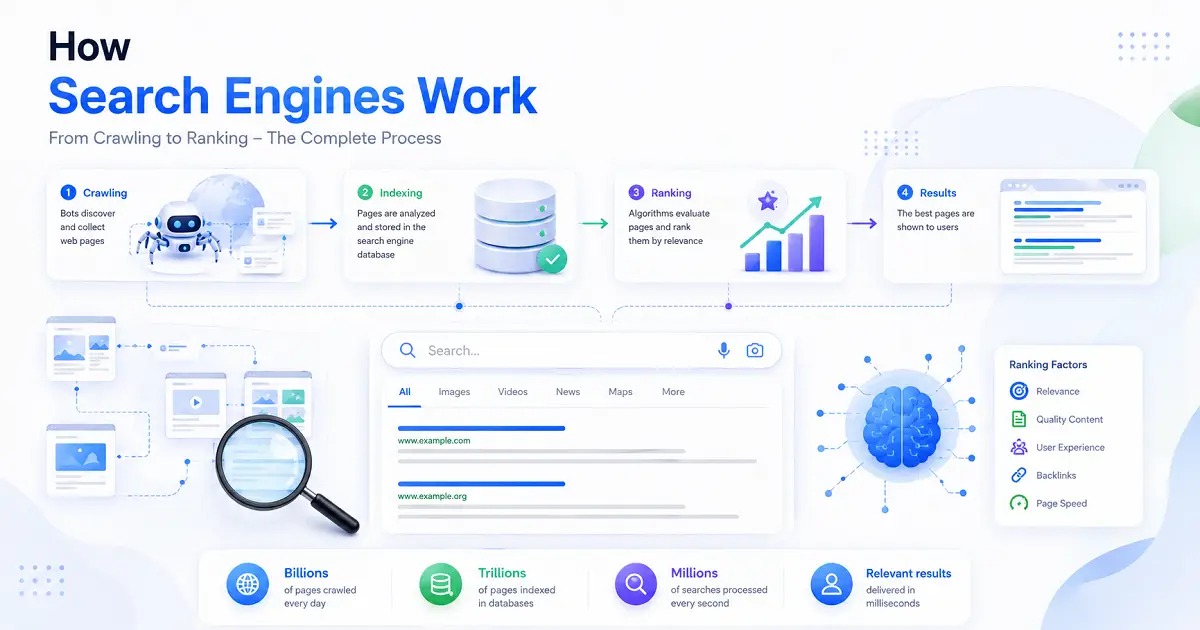
The Crawling Process Explained
The crawling stage is the first step in the search process.
- A crawler discovers a webpage through links or a sitemap.
- It visits the page and downloads its content.
- It reads headings, paragraphs, images, links, and metadata.
- It follows additional links found on the page.
- The collected information is sent back for indexing.
At this stage, the search engine is only collecting information. It has not yet decided where the page should appear in search results.
Why Internal Links Matter
Internal links help search engines discover more pages on your website. When one article naturally links to another related article, crawlers can move through your website more efficiently.
For example, someone learning about search engines may also want to understand how websites are built. That's why connecting related topics improves both the user experience and website structure.
If you'd like to understand the foundation of modern websites, continue with our guide on Web Development Basics for Beginners. It explains how websites are created before they become searchable on Google.
Does Every Crawled Page Appear on Google?
No. Discovering a webpage is only the first step. After crawling, search engines evaluate the page before deciding whether it deserves to be included in their index.
Pages with useful, original, and well-structured content have a much better chance of moving to the next stage. Pages that contain duplicate information, very little content, or technical problems may never be indexed at all.
In the next section, we'll look at how indexing works, why some pages never appear in search results, and how Google decides which pages deserve visibility.
What Happens During Indexing?
After a search engine discovers a webpage through crawling, it doesn't immediately display that page in search results. The next stage is called indexing. During this process, the search engine carefully examines the webpage and decides whether it should be stored in its massive database.
Think of an index as a digital library. Every book in a library has its own place, making it easy to find later. Search engines work in a similar way. They organize billions of webpages so they can quickly retrieve the most relevant results whenever someone performs a search.
If a webpage isn't indexed, it won't appear in search results, no matter how useful the content may be.
What Information Does Google Store?
When Google indexes a webpage, it doesn't simply save the URL. It analyzes many different elements to understand what the page is about.
- Page title
- Main headings
- Article content
- Images and their descriptions
- Internal links
- External links
- Meta description
- Structured page layout
This information helps Google understand both the topic and the overall quality of the page before deciding when it should appear in search results.
Why Some Pages Never Get Indexed
Many beginners assume that publishing a webpage automatically guarantees visibility on Google. Unfortunately, that's not how search engines work.
Google may choose not to index a page for several reasons.
- The content is too short or lacks useful information.
- The page contains mostly duplicate content.
- The page has technical issues that prevent crawling.
- A "noindex" directive blocks search engines.
- The page offers little value compared to similar pages already available.
This is why creating original, informative, and well-organized content is so important for long-term search visibility.
Understanding Search Rankings
Once a webpage has been indexed, the next challenge begins—ranking.
Every time someone searches on Google, millions of relevant pages may exist for the same topic. Google must decide which pages deserve the top positions.
Its ranking systems evaluate hundreds of signals to estimate which pages are most likely to satisfy the user's search intent.
The pages that provide the best overall experience generally have a greater chance of appearing near the top of search results.
Important Factors That Influence Rankings
Google doesn't reveal every ranking signal it uses, but several important factors are widely understood to influence search visibility.
Helpful Content
Content should answer the reader's question clearly and completely. Articles that genuinely educate or solve problems tend to perform better than pages created only to attract traffic.
Content Quality
Well-written articles with accurate information, logical structure, and practical examples are generally considered more valuable than thin or repetitive content.
User Experience
Visitors expect websites to load quickly, work well on mobile devices, and provide easy navigation. A positive browsing experience encourages users to stay longer and explore additional pages.
Page Structure
Using descriptive headings, organized paragraphs, meaningful titles, and properly structured HTML helps both readers and search engines understand your content more effectively.
Internal Linking
Connecting related articles naturally helps users continue learning while also allowing search engines to discover additional pages on your website.
What Is Search Intent?
Search intent refers to the reason behind a user's search.
Someone searching for "What is web hosting?" expects an educational explanation, while someone searching for "buy web hosting" is probably looking for a service provider.
Understanding this difference is essential when writing articles because search engines try to match results with the user's actual intention rather than simply matching keywords.
Why Keywords Still Matter
Keywords continue to play an important role in search engine optimization, but they should be used naturally.
Instead of repeating the same phrase throughout an article, focus on writing comprehensive content that answers related questions.
Modern search engines understand context much better than they did years ago. They recognize similar words, related topics, and the overall meaning of a page instead of relying only on exact keyword matches.
On-Page SEO Explained
On-page SEO includes all the improvements made directly on a webpage to help both users and search engines understand the content.
Common on-page SEO practices include:
- Writing descriptive page titles.
- Using clear heading structures.
- Adding informative meta descriptions.
- Creating original content.
- Optimizing images.
- Including relevant internal links.
- Improving readability.
Small improvements in these areas can significantly improve both user experience and search visibility over time.
Technical SEO Makes Everything Work Better
Even excellent content may struggle if technical issues prevent search engines from accessing the website.
Technical SEO focuses on improving the website's underlying structure rather than its written content.
Important technical elements include page speed, mobile responsiveness, XML sitemaps, HTTPS security, crawlability, structured URLs, and proper indexing.
If you're interested in understanding how websites become available online before search engines can crawl them, our guide on What Is Web Hosting? explains how hosting stores website files and delivers them to visitors around the world.
How Search Engines Decide Which Page Appears First
After a webpage has been crawled and indexed, the final challenge is deciding where it should appear in search results. This process is known as ranking. Every time someone searches on Google, millions of webpages may be relevant to that query, but only a handful appear on the first page.
Search engines analyze hundreds of ranking signals to estimate which page is most likely to satisfy the user's search. Instead of choosing pages randomly, they evaluate relevance, usefulness, page quality, and overall user experience before displaying the results.
This means that publishing an article alone isn't enough. A page must also demonstrate that it deserves a higher position than competing pages covering the same topic.
Why High-Quality Content Matters More Than Ever
Years ago, simply repeating keywords throughout a webpage could sometimes improve rankings. Modern search engines are much smarter. They focus on understanding whether the content genuinely helps readers.
A high-quality article usually explains a topic clearly, answers common questions, provides accurate information, and keeps readers engaged from beginning to end.
When visitors find exactly what they were looking for, they're more likely to stay on the page longer, explore additional articles, and return to the website later. These positive experiences help search engines recognize that the page is valuable.
What Makes a Helpful Webpage?
Although every website is different, helpful pages usually have several things in common.
- Clear and descriptive headings.
- Original information written for real people.
- Simple explanations that are easy to understand.
- Logical organization from beginning to end.
- Useful examples that make concepts easier to understand.
- Fast loading speed.
- A good experience on both desktop and mobile devices.
When these elements come together, readers spend more time exploring the content instead of leaving immediately.
Why Website Structure Is So Important
Imagine entering a library where every book has been placed randomly without shelves or labels. Finding the right book would be frustrating.
The same principle applies to websites.
A well-organized website helps both visitors and search engines understand where information is located. Clear navigation menus, meaningful URLs, logical categories, and proper internal links make it much easier to move from one topic to another.
Search engines also use this structure to discover additional pages and understand how different articles relate to one another.
How Internal Links Improve SEO
Internal links connect one page of your website to another related page. They serve two important purposes.
First, they help visitors continue learning by suggesting relevant articles.
Second, they help search engine crawlers discover additional content that may otherwise receive fewer visits.
For example, someone reading about search engines may naturally want to understand web hosting, domain names, or responsive web design. Linking related articles creates a smoother learning experience while strengthening your website's overall structure.
If you're planning to publish your own website, it's worth understanding What Is a Domain Name and How Does It Work?. A domain name gives your website a memorable address that visitors can easily type into their browser.
Can Great Design Improve Rankings?
Design alone won't guarantee better rankings, but it can significantly improve user experience.
Visitors appreciate websites that are clean, readable, and easy to navigate. Large headings, comfortable spacing, responsive layouts, and readable fonts make content more enjoyable to read.
Poor design often causes visitors to leave quickly, especially on mobile devices.
Modern search engines recognize that user experience matters, which is why responsive and accessible websites generally perform better over time.
To understand how websites automatically adapt to different screen sizes, read our guide on Responsive Web Design Explained for Beginners.
How Long Does It Take to Rank on Google?
One of the most common questions beginners ask is how quickly a new webpage will appear in search results.
Unfortunately, there isn't a fixed answer.
Some pages are discovered and indexed within a few days, while others may take several weeks or even months. The timing depends on factors such as website authority, content quality, technical health, internal linking, and how often search engines revisit the website.
Publishing helpful content consistently is usually far more effective than expecting immediate rankings.
Common SEO Mistakes Beginners Should Avoid
Many website owners unintentionally reduce their chances of ranking well because they focus on shortcuts instead of building genuinely useful content.
- Publishing thin articles with very little information.
- Copying content from other websites.
- Using excessive keywords unnaturally.
- Ignoring mobile users.
- Creating confusing website navigation.
- Leaving broken internal links.
- Publishing pages without updating them.
Avoiding these mistakes helps build a stronger website that both users and search engines can trust.
Search Is Constantly Evolving
Search engines continue improving every year. Modern ranking systems are far better at understanding language, recognizing search intent, and identifying genuinely helpful content than they were a decade ago.
Instead of trying to manipulate rankings, successful website owners focus on creating accurate, useful, and well-organized content that answers real questions.
This approach not only improves search visibility but also builds long-term trust with readers.
What's Next After Understanding Search Engines?
Learning how search engines work gives you a strong foundation for understanding SEO, website optimization, and online publishing.
The next step is learning how websites are hosted, how domain names work, and how different technologies connect to create a complete online experience.
Once you understand these concepts together, you'll have a much clearer picture of how modern websites are built, published, discovered, and continuously improved.
Frequently Asked Questions
1. How do search engines find new websites?
Search engines use automated programs called web crawlers or bots to discover new webpages. These crawlers follow links from one page to another, read website content, and report the information back to the search engine's index. Website owners can also submit XML sitemaps to help search engines discover their pages more efficiently.
2. What is the difference between crawling and indexing?
Crawling is the process of discovering and visiting webpages. Indexing happens after crawling, when the search engine analyzes the page and decides whether it should be stored in its searchable database. A page can be crawled without being indexed if it doesn't meet quality or technical requirements.
3. Why isn't my website appearing on Google?
There are several possible reasons. Your website may not have been crawled yet, the page could be blocked from indexing, the content may be too thin, or Google may still be evaluating its quality. Technical issues such as incorrect robots directives or poor website structure can also delay indexing.
4. Does publishing more articles improve rankings?
Publishing more articles can help only if they provide genuine value. Search engines prefer useful, original, and well-structured content over large numbers of short or repetitive articles. A smaller collection of high-quality pages usually performs better than hundreds of low-value posts.
5. How important are internal links?
Internal links are extremely important because they help visitors discover related content while allowing search engine crawlers to navigate your website more efficiently. A logical internal linking structure also helps search engines understand the relationship between different topics.
6. Do search engines rank websites instantly?
No. Ranking takes time. New pages must first be discovered, crawled, indexed, and evaluated before they can appear in search results. Depending on the website and competition, this process may take anywhere from a few days to several weeks.
7. Is SEO only about keywords?
No. Modern SEO includes much more than keywords. Search engines evaluate content quality, user experience, mobile friendliness, page speed, internal linking, website structure, technical health, and many other factors when determining rankings.
8. What should I learn after understanding search engines?
Once you understand how search engines discover and rank websites, it's helpful to learn about web hosting, domain names, frontend and backend development, responsive web design, and APIs. Together, these topics explain how websites are created, published, and made accessible to users around the world.
Related Articles
- Web Development Basics for Beginners
- What Is an API and How Does It Work?
- What Is Web Hosting? Everything Beginners Need to Know
- What Is a Domain Name and How Does It Work?
- Frontend vs Backend Development: What's the Difference?
- Responsive Web Design Explained for Beginners
- Best Programming Languages for Beginners in 2026
Final Thoughts
Search engines have transformed the way people access information. Instead of remembering thousands of website addresses, users simply type a question into a search box and receive relevant results within seconds. Behind that simple experience is a sophisticated system that continuously discovers, analyzes, indexes, and ranks billions of webpages.
For website owners, understanding how search engines work is just as important as learning how to build a website. Even an attractive website with excellent content can struggle to reach readers if search engines cannot crawl, index, or properly understand its pages.
The most effective long-term SEO strategy isn't based on shortcuts or tricks. It comes from creating original content, organizing your website clearly, improving user experience, maintaining strong technical foundations, and publishing information that genuinely helps readers solve their problems.
As search technology continues to evolve, one principle remains consistent: websites that provide useful, trustworthy, and well-organized content are far more likely to earn visibility over time. Instead of focusing only on rankings, focus on building pages that people enjoy reading and returning to.
Whether you're creating a personal blog, an educational website, a business platform, or an online portfolio, understanding how search engines work gives you a strong foundation for growing your visibility and reaching more people through organic search.
Continue Learning with TypeNest
Understanding how search engines work is one of the best ways to build better websites and create content that people can actually find online. Once you understand crawling, indexing, and ranking, topics like SEO and website optimization become much easier to learn.
Keep exploring web technologies, practice creating useful content, and continue learning how websites, search engines, and the internet work together to deliver information to millions of users every day.
Last Updated: July 2026
Author: TypeNest Editorial Team