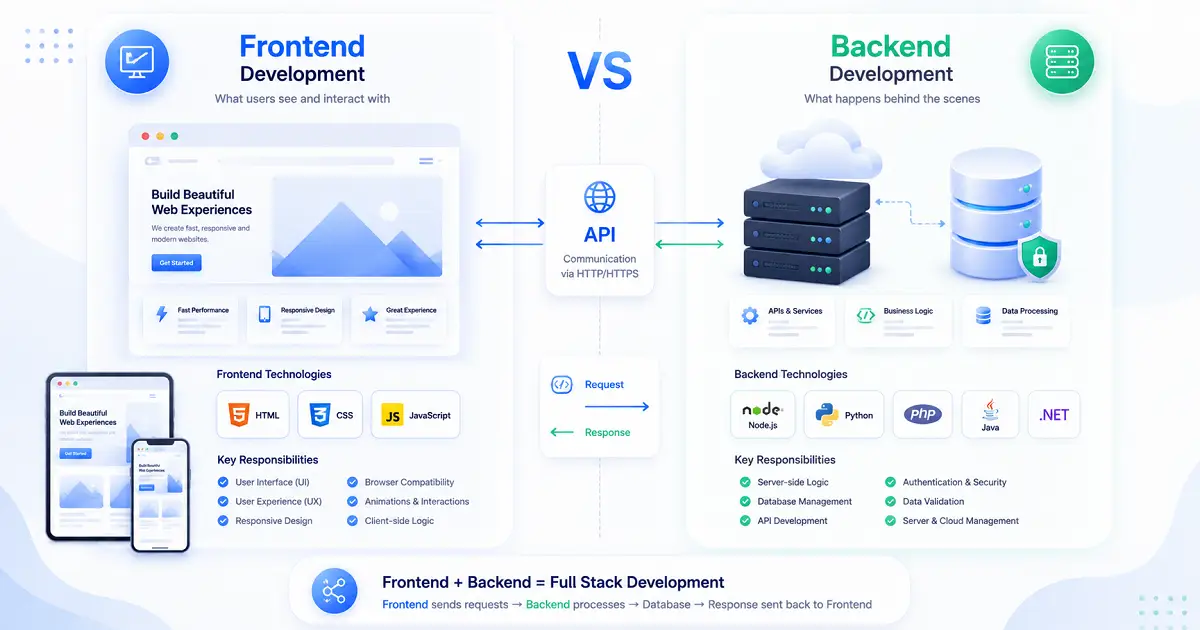
Every Modern Website Has Two Sides
Whenever you open a website, shop online, sign in to your account, or watch a video, you're interacting with a system that's doing much more than simply displaying information on your screen. Behind every modern website are two essential parts working together continuously: Frontend Development and Backend Development.
Although users experience a website as a single product, developers build it using different technologies that handle different responsibilities. One part focuses on everything visitors can see and interact with, while the other manages the logic, data, and processes happening behind the scenes.
Understanding the difference between frontend and backend development is one of the most important milestones for anyone beginning their web development journey. It helps you understand how websites are built, how different technologies work together, and which development path may be the best fit for your interests and career goals.
In this guide, we'll explore frontend and backend development using simple explanations and practical examples. Rather than comparing technical definitions, we'll focus on how these technologies work together to create the websites and web applications people use every day.
What Is Frontend Development?
Frontend development is the part of a website that users directly see and interact with inside a web browser. Every visual element—from the navigation menu and images to buttons, forms, colors, and animations—is created by frontend developers.
Its primary goal is to provide an attractive, responsive, and user-friendly experience regardless of whether someone visits the website from a desktop computer, tablet, or smartphone.
Whenever you click a button, open a menu, type into a search box, or navigate between pages, you're interacting with the frontend of the website.
A Simple Real-Life Example
Imagine visiting a modern restaurant.
The dining area, furniture, decorations, menu cards, lighting, and customer service are everything guests experience directly.
Behind the kitchen doors, however, chefs prepare food, manage ingredients, receive orders, and coordinate with staff.
A website works in a very similar way.
- The dining area represents the frontend.
- The kitchen represents the backend.
- The customer is the website visitor.
- The waiter acts as the connection between both sides.
Customers only see the finished experience, but both teams must work together perfectly to provide excellent service.
What Does a Frontend Developer Actually Build?
Frontend developers are responsible for creating everything users experience visually.
Their work combines design, usability, accessibility, and performance to ensure websites are enjoyable and easy to use.
Some common frontend components include:
- Navigation menus
- Buttons and forms
- Images and galleries
- Landing pages
- Product cards
- Shopping carts
- Dashboards
- Dark mode
- Animations
- Responsive layouts
A frontend developer doesn't simply make websites "look good." They also ensure visitors can use every feature comfortably across different screen sizes and devices.
Technologies Used in Frontend Development
Modern frontend development is built on three fundamental technologies. Nearly every website on the internet uses these technologies in some form.
HTML
HTML creates the structure of a webpage.
Headings, paragraphs, buttons, images, links, forms, tables, and lists are all defined using HTML.
Without HTML, a browser would have no information about how a webpage should be organized.
CSS
CSS controls how that structure appears.
Colors, fonts, layouts, spacing, shadows, animations, responsive behavior, and visual styling are all handled through CSS.
Good CSS transforms plain HTML into an attractive, professional-looking website.
JavaScript
JavaScript brings webpages to life.
Interactive menus, sliders, live search, popups, notifications, validation messages, calculators, and dynamic content all rely on JavaScript.
Instead of showing static pages, JavaScript allows websites to respond immediately to user actions.
Why Frontend Development Matters
Visitors often form an opinion about a website within just a few seconds.
If navigation feels confusing, pages load slowly, buttons don't work correctly, or text is difficult to read, users may leave before exploring the website further.
This makes frontend development one of the most important aspects of creating successful websites.
A well-designed frontend improves usability, builds trust, increases visitor engagement, and encourages users to spend more time exploring the website.
Responsive Design Is Part of Frontend Development
People no longer browse websites using only desktop computers.
Today, websites must work equally well on smartphones, tablets, laptops, and large desktop monitors.
Frontend developers use responsive design techniques to automatically adjust layouts according to different screen sizes.
Without responsive design, users would constantly zoom, scroll sideways, or struggle to navigate websites on smaller devices.
If you'd like to understand this concept in more detail, continue with our guide on Responsive Web Design Explained for Beginners .
Frontend Alone Cannot Build a Complete Website
Although frontend development creates everything users can see, it cannot store user accounts, process payments, save information, or manage databases by itself.
Those responsibilities belong to backend development.
Frontend and backend developers work together continuously. The frontend collects information from users, while the backend processes that information and sends appropriate responses back to the browser.
Understanding this relationship makes it much easier to appreciate how modern websites actually function.
In the next section, we'll explore backend development, learn what happens behind the scenes, and compare how both technologies work together to power today's web applications.
What Is Backend Development?
While the frontend is responsible for everything users can see, backend development manages everything happening behind the scenes. Most visitors never interact directly with the backend, yet almost every action they perform on a website depends on it.
Whenever you sign in to an account, submit a registration form, upload a photo, complete an online payment, or update your profile, backend systems receive that information, process it, and return the appropriate response.
Without backend development, websites would simply display static pages. They wouldn't be able to remember users, store information, process requests, or provide personalized experiences.
A Simple Example Everyone Can Relate To
Imagine you're shopping on an online store.
You browse products, add items to your cart, and finally click the Buy Now button.
At first glance, it seems like only one button was clicked.
In reality, the backend performs several tasks almost instantly.
- Checks whether the product is still available.
- Calculates the final price.
- Applies discounts if available.
- Processes the payment.
- Creates the order.
- Updates inventory.
- Sends a confirmation email.
All of these operations happen behind the scenes without the customer ever seeing them.
What Does a Backend Developer Build?
Backend developers create the systems that allow websites to function beyond simple webpages.
Their work focuses on performance, security, data management, and business logic rather than visual design.
Typical backend responsibilities include:
- User authentication
- Database management
- Payment processing
- API development
- Server management
- Security implementation
- Business logic
- Data processing
- Cloud integration
- Performance optimization
Although visitors rarely notice backend systems directly, they rely on them every time they use a modern website.
The Main Components of Backend Development
Backend development combines several technologies that work together to process requests and manage website data.
Servers
A server is a powerful computer that stores website files and responds whenever someone visits the website.
Every time a visitor requests a webpage, the server receives that request, processes it, and sends the appropriate response back to the browser.
Databases
Databases permanently store website information.
Whenever users create accounts, publish comments, purchase products, or save personal information, that data is usually stored inside a database.
Instead of losing information every time the website closes, databases preserve it for future use.
Application Logic
Application logic determines how a website should respond in different situations.
For example, if a customer enters an incorrect password, the backend displays an error message instead of granting access.
If payment succeeds, the backend confirms the order and updates inventory automatically.
Authentication
Authentication verifies a user's identity.
Every time you log into a website, backend systems check whether your username and password match the stored records.
Only after successful verification does the website allow access to your account.
Backend Programming Languages
Unlike frontend development, which mainly relies on HTML, CSS, and JavaScript, backend development supports many programming languages.
Each language has its own strengths, and companies choose different technologies depending on their projects.
- JavaScript (Node.js)
- Python
- Java
- PHP
- C#
- Go
- Ruby
Although each language works differently, they all help developers build secure, scalable server-side applications.
Frontend and Backend Work Together
Many beginners imagine frontend and backend as completely separate systems.
In reality, they communicate continuously.
Consider a simple login page.
- The frontend displays the login form.
- The user enters their email and password.
- The backend receives the information.
- The database checks the credentials.
- The backend returns the result.
- The frontend displays either the dashboard or an error message.
Although the visitor only sees a login form, both frontend and backend are working together throughout the entire process.
How APIs Connect Both Sides
Frontend and backend applications don't communicate directly without a defined method.
This communication usually happens through APIs (Application Programming Interfaces).
Whenever the frontend needs information—such as user profiles, product lists, weather updates, or payment confirmations—it sends a request through an API.
The backend processes that request and returns the required information.
If you're unfamiliar with APIs, our guide on What Is an API and How Does It Work? explains this communication process in much greater detail.
Why Security Is Primarily a Backend Responsibility
Modern websites store enormous amounts of sensitive information, including passwords, payment details, customer records, and business data.
Protecting this information is one of the backend developer's most important responsibilities.
Security measures such as encrypted passwords, secure authentication, access control, server validation, and protected databases all operate behind the scenes to keep websites safe.
In the next section, we'll compare frontend and backend development directly, explore which path is better for beginners, discuss career opportunities, and help you decide which development field best matches your interests.
Frontend vs Backend: A Side-by-Side Comparison
Now that you've learned what frontend and backend development do individually, it's much easier to compare them directly. Although both are essential for building modern websites, they focus on completely different responsibilities.
Frontend development is concerned with what visitors see and interact with, while backend development focuses on processing information, managing data, and ensuring everything works correctly behind the scenes.
| Frontend Development | Backend Development |
|---|---|
| Visible to users | Runs behind the scenes |
| Creates layouts and interfaces | Processes user requests |
| Uses HTML, CSS and JavaScript | Uses languages like Python, Java, PHP and Node.js |
| Runs inside the web browser | Runs on web servers |
| Focuses on user experience | Focuses on security, databases and business logic |
| Handles responsiveness and design | Handles APIs, authentication and data management |
Which One Should Beginners Learn First?
This is probably the most common question asked by people who are starting web development.
For most beginners, learning frontend development first is the better choice.
Frontend technologies provide immediate visual feedback. Every time you write HTML or CSS, you can instantly see the result in your browser. This makes learning more enjoyable and helps beginners understand how websites are structured.
Once you're comfortable building webpages and understanding how users interact with websites, moving into backend development becomes much easier because you already understand how the frontend behaves.
A Recommended Learning Roadmap
Instead of trying to learn everything at once, follow a structured learning path.
- HTML
- CSS
- JavaScript
- Responsive Web Design
- Frontend Development
- Backend Development
- APIs
- Databases
- Authentication
- Deployment
Each topic builds naturally on the previous one, making the learning process much less overwhelming.
What Is a Full Stack Developer?
A Full Stack Developer understands both frontend and backend development.
Instead of specializing in only one side of a website, full stack developers can design user interfaces, write server-side code, manage databases, build APIs, and deploy complete web applications.
Because they understand the entire development process, full stack developers are highly valued by startups, software companies, and freelance clients.
However, becoming a full stack developer doesn't mean learning everything at once. Most professionals first become comfortable with frontend development before gradually expanding into backend technologies.
Career Opportunities
As businesses continue expanding their digital presence, demand for skilled web developers remains strong across many industries.
Different organizations require different types of developers depending on the projects they build.
- Frontend Developer
- Backend Developer
- Full Stack Developer
- UI Developer
- Software Engineer
- Web Application Developer
- Cloud Developer
- Technical Consultant
Many developers also work as freelancers, building websites and web applications for businesses around the world.
Skills That Matter Beyond Programming
Learning programming languages is important, but successful developers also develop several non-technical skills throughout their careers.
- Problem-solving ability
- Logical thinking
- Communication skills
- Patience while debugging
- Attention to detail
- Continuous learning
- Time management
Technology changes rapidly, so developers who continue learning throughout their careers usually adapt more successfully than those who stop after learning a few programming languages.
Common Mistakes Beginners Should Avoid
Trying to Learn Too Many Languages
Many beginners start learning HTML, CSS, JavaScript, Python, Java, React, Node.js, and databases simultaneously.
This often leads to confusion rather than progress.
Focus on mastering one technology before moving to the next.
Ignoring HTML and CSS
Some learners rush directly into JavaScript frameworks without developing a strong understanding of HTML and CSS.
Since these technologies form the foundation of frontend development, skipping them usually creates problems later.
Watching Tutorials Without Building Projects
Watching videos can teach concepts, but real learning happens when you build websites yourself.
Every project improves your confidence and exposes you to real-world challenges that tutorials often don't cover.
Not Learning Responsive Design
Modern websites must work across phones, tablets, laptops, and desktop computers.
Ignoring responsive design creates websites that look good on one device but become difficult to use on others.
How Frontend and Backend Connect With Other Web Technologies
Frontend and backend development don't exist in isolation.
Modern websites combine several technologies working together.
- Web development creates the website.
- Frontend builds the user interface.
- Backend processes data and business logic.
- APIs connect different systems.
- Web hosting stores the website.
- Domain names provide an easy-to-remember address.
- Search engines help people discover the website.
Understanding how these technologies connect provides a much stronger foundation than learning each topic separately.
If you're continuing your web development journey, our articles on Web Hosting, Domain Names, and How Search Engines Work will help you understand how websites move from development to becoming accessible on the internet.
In the final section, we'll answer common questions, recommend related articles, summarize everything you've learned, and help you decide which development path is right for your goals.
Frequently Asked Questions
1. What is the biggest difference between frontend and backend development?
Frontend development focuses on everything users can see and interact with, including layouts, buttons, forms, navigation menus, and responsive designs. Backend development works behind the scenes by processing requests, managing databases, handling authentication, and running the business logic that powers a website.
2. Which is easier to learn for beginners?
Most beginners find frontend development easier because it provides immediate visual results. As you write HTML and CSS, you can instantly see changes in your browser. Backend development usually involves additional concepts such as servers, databases, APIs, and security, which often require a stronger technical foundation.
3. Can I become a web developer by learning only frontend?
Yes. Many professional developers work exclusively as frontend developers. They specialize in building user interfaces, improving user experience, and creating responsive websites. However, learning backend development later can expand your career opportunities and help you understand how complete web applications work.
4. Do frontend developers need to understand backend development?
Basic backend knowledge is very helpful because frontend applications frequently communicate with backend services through APIs. Even if you don't become a backend developer, understanding how data flows between both sides makes collaboration much easier.
5. What skills are required to become a Full Stack Developer?
A Full Stack Developer usually understands HTML, CSS, JavaScript, responsive web design, frontend frameworks, backend programming, databases, APIs, authentication, version control, and website deployment. These skills are typically learned step by step over time rather than all at once.
6. Which career has better job opportunities?
Both frontend and backend developers are in high demand. Companies need specialists in both areas to build secure, fast, and user-friendly web applications. Choosing one over the other should depend more on your interests than on job availability.
7. Can one person handle both frontend and backend?
Yes. Developers who work on both areas are known as Full Stack Developers. They can build complete web applications from the user interface to the database and server logic. Many startups and freelance projects prefer full stack developers because they can manage multiple aspects of a project.
8. What should I learn after understanding frontend and backend development?
Once you understand these concepts, continue learning about responsive web design, APIs, databases, web hosting, domain names, version control, and deployment. Together, these topics provide a complete understanding of modern web development.
Related Articles
If you're exploring web development, these beginner-friendly guides will help you understand the technologies that work alongside frontend and backend development.
- Web Development Basics for Beginners
- What Is an API and How Does It Work?
- How Search Engines Work: A Beginner's Guide to Google Search
- What Is Web Hosting? Everything Beginners Need to Know
- What Is a Domain Name and How Does It Work?
- Responsive Web Design Explained for Beginners
- Best Programming Languages to Learn in 2026
Final Thoughts
Frontend and backend development are two equally important parts of every modern website. While frontend developers create the visual experience that users interact with, backend developers build the systems that process information, manage databases, secure user accounts, and ensure everything works reliably behind the scenes.
Rather than thinking of these fields as competitors, it's better to see them as partners. A beautiful website without a reliable backend cannot provide dynamic features such as user accounts or online payments. Likewise, even the most powerful backend will struggle if visitors find the interface confusing or difficult to use.
If you're just beginning your web development journey, starting with frontend technologies such as HTML, CSS, and JavaScript is usually the most practical approach. These technologies help you understand how websites are structured and provide immediate visual feedback while you learn. As your confidence grows, you can gradually explore backend programming, databases, APIs, authentication, and deployment.
The demand for skilled web developers continues to grow because organizations of every size depend on websites and web applications. Whether you choose to specialize in frontend development, backend development, or eventually become a Full Stack Developer, building a strong foundation and gaining hands-on project experience will help you progress more confidently.
Keep learning one concept at a time, build real projects whenever possible, and focus on understanding how different web technologies connect. That practical approach will prepare you far better than simply memorizing programming syntax and will make your journey into web development both more enjoyable and more rewarding.
Continue Learning with TypeNest
Frontend and backend development are two essential parts of every modern website and web application. As you continue learning, understanding how these technologies work together will help you choose the right development path and build more complete projects.
Keep exploring beginner-friendly guides on web development, programming, hosting, and related technologies to strengthen your technical skills and gain confidence as a future developer.
Last Updated: July 2026
Author: TypeNest Editorial Team