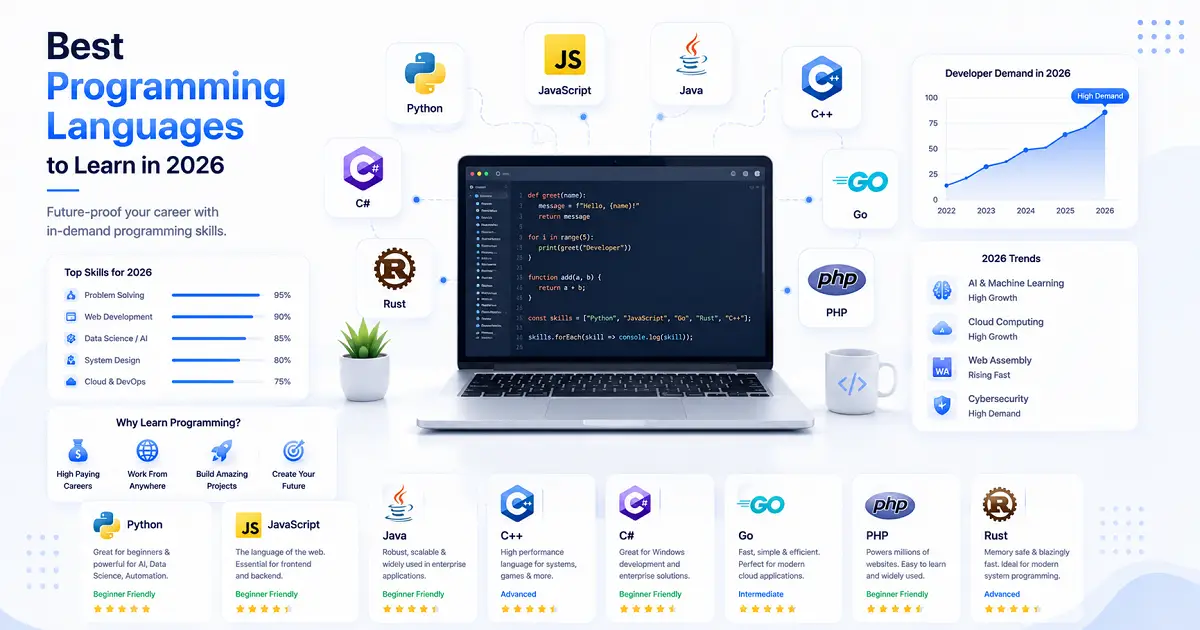
Why Learning Programming Is More Valuable Than Ever
Technology has become a part of almost every aspect of modern life. Whether you shop online, use a banking app, book a cab, stream videos, or browse social media, software is working behind the scenes to make these services possible. At the heart of every software application is programming.
Programming is no longer a skill reserved only for software engineers. Today, professionals in healthcare, finance, education, manufacturing, marketing, research, and many other industries use programming to solve problems, automate tasks, analyze data, and build digital products.
As businesses continue adopting new technologies, the demand for skilled programmers continues to grow. Learning a programming language not only opens career opportunities but also improves logical thinking, creativity, and problem-solving abilities.
If you're planning to enter the technology industry in 2026, learning programming is one of the smartest long-term investments you can make. The challenge isn't deciding whether programming is worth learning—it's deciding where to begin.
In this guide, you'll learn what programming languages are, why they matter, how to choose your first language, and which programming languages are expected to remain valuable throughout 2026 and beyond.
What Is a Programming Language?
A programming language is a structured method of communicating with a computer. Just as people use spoken and written languages to communicate with one another, programmers use programming languages to give computers instructions.
These instructions tell computers exactly what actions to perform. They might display a webpage, calculate numbers, save information inside a database, process online payments, or even control robots and smart devices.
Although every programming language has its own syntax and style, they all share the same purpose: helping developers build software that solves real-world problems.
How Computers Understand Programs
Computers don't understand English or any other human language naturally. Instead, they understand machine instructions made up of binary values.
Programming languages act as translators between humans and computers.
Developers write readable code using languages such as Python, JavaScript, Java, or C++, and specialized software converts that code into instructions the computer can execute.
This allows programmers to build everything from simple calculators to advanced artificial intelligence systems without writing directly in machine code.
Programming Is Everywhere
Many beginners assume programming is only used to build websites.
In reality, programming powers nearly every modern technology we interact with every day.
- Websites
- Mobile applications
- Online banking systems
- Artificial intelligence
- Cloud computing platforms
- Cybersecurity tools
- Operating systems
- Video games
- Smart devices
- Business software
Whether you're ordering food online or watching your favorite movie, programming languages are working behind the scenes.
Why Learn Programming in 2026?
Technology continues to evolve rapidly, creating new opportunities for developers across almost every industry.
Companies are investing heavily in software development, automation, cloud infrastructure, artificial intelligence, and digital transformation. As a result, skilled programmers remain in high demand worldwide.
Learning programming can lead to careers in web development, software engineering, mobile app development, cloud computing, cybersecurity, DevOps, data science, machine learning, and many other technology fields.
Even people who don't plan to become professional developers often benefit from programming because it strengthens logical thinking and teaches a structured approach to solving problems.
Benefits of Learning Programming
- Strong career opportunities.
- Competitive salaries.
- Remote and freelance work options.
- Ability to build websites and applications.
- Improved logical thinking.
- Better problem-solving skills.
- Opportunities to automate repetitive tasks.
- Continuous learning and career growth.
How to Choose Your First Programming Language
One of the biggest mistakes beginners make is searching for the single "best" programming language.
The truth is that no programming language is perfect for every situation.
Different languages are designed for different types of projects. Instead of following internet rankings blindly, choose a language based on what you want to build.
Ask yourself a few simple questions.
- Do you want to build websites?
- Are you interested in software development?
- Would you like to create mobile apps?
- Do you enjoy working with data?
- Are you interested in automation?
- Would you like to develop games?
Your answers will naturally point you toward the programming languages most suitable for your goals.
Different Career Goals Require Different Languages
Someone interested in web development usually begins with HTML, CSS, JavaScript, and later explores backend programming.
A future Android developer may choose Kotlin, while someone building iPhone applications often learns Swift.
Developers interested in enterprise software frequently work with Java or C#, whereas cloud engineers often use Go.
Understanding your long-term goal helps you avoid learning technologies that aren't relevant to your interests.
Programming Works Together With Other Web Technologies
Programming languages don't work in isolation.
Modern websites combine several technologies that work together to create complete web applications.
Frontend developers build the user interface, backend developers create the server-side logic, APIs allow different systems to communicate, hosting stores website files, and domain names help users access websites through simple addresses.
If you're new to web development, our guide on Web Development Basics for Beginners provides an excellent introduction to how websites are created before programming languages are used to add advanced functionality.
You'll also benefit from reading Frontend vs Backend Development , which explains how programming languages are used on both the client side and the server side of modern web applications.
The Most Popular Programming Languages in 2026
Although hundreds of programming languages exist, only a relatively small number dominate professional software development.
Each language offers unique strengths and is designed for particular types of projects.
In the next section, we'll explore the most popular programming languages of 2026—including Python, JavaScript, Java, C++, and C#—along with their strengths, common applications, and the types of careers they're best suited for.
1. Python
Python has remained one of the world's most popular programming languages for many years, and its popularity continues to grow in 2026. One of the biggest reasons beginners choose Python is its clean and readable syntax. Unlike many other programming languages, Python allows developers to write programs that are easy to understand, making the learning process much less intimidating.
Python is extremely versatile. Instead of focusing on a single field, it is used across web development, automation, artificial intelligence, machine learning, cybersecurity, scientific computing, and data analysis. This flexibility makes it one of the safest choices for beginners who haven't yet decided on a specific career path.
Another major advantage of Python is its enormous community. Millions of developers contribute tutorials, frameworks, libraries, and learning resources, making it easier to solve problems and continue learning.
Popular Uses- Artificial Intelligence
- Machine Learning
- Data Science
- Automation
- Cybersecurity
- Backend Web Development
Python is an excellent first programming language because it teaches programming fundamentals while remaining useful throughout a developer's career.
2. JavaScript
JavaScript is the language that powers the interactive web. Almost every modern website uses JavaScript to create dynamic user experiences.
Whenever you open a navigation menu, submit a contact form, view image sliders, receive notifications, or interact with dashboards, JavaScript is usually working behind the scenes.
Unlike most programming languages, JavaScript runs directly inside every modern web browser. This makes it an essential skill for anyone interested in web development.
Its capabilities have expanded significantly over the years. With technologies such as Node.js, JavaScript is no longer limited to frontend development. Developers now use it to build backend servers, APIs, real-time applications, and even desktop and mobile applications.
Popular Uses- Frontend Development
- Backend Development
- Interactive Websites
- Single Page Applications
- Mobile Applications
- Real-Time Applications
If your goal is becoming a web developer, JavaScript is one of the most important programming languages you'll learn.
To better understand how JavaScript fits into modern websites, read our guide on Frontend vs Backend Development .
3. Java
Java has been trusted by businesses and software companies for decades. Even in 2026, it continues to power enterprise software, banking systems, business applications, and Android development.
One of Java's greatest strengths is portability. Programs written in Java can run on multiple operating systems with very few changes, making it a practical choice for large organizations.
Java is also known for its reliability, security, and scalability. Because of these qualities, it remains widely used by financial institutions, healthcare systems, government organizations, and multinational companies.
Popular Uses- Enterprise Software
- Android Applications
- Business Systems
- Cloud Applications
- Financial Platforms
Although Java requires more code than Python, it provides a strong understanding of object-oriented programming and software architecture.
4. C++
C++ is one of the most powerful programming languages available today. It gives developers greater control over computer hardware, memory management, and system performance.
Because of its speed and efficiency, C++ remains a popular choice for applications where performance is critical.
Game engines, operating systems, embedded software, robotics, simulation software, and high-performance applications frequently rely on C++.
Learning C++ can be more challenging than learning Python or JavaScript because it introduces lower-level programming concepts. However, those concepts also help developers gain a deeper understanding of how computers actually work.
Popular Uses- Game Development
- Operating Systems
- Embedded Systems
- Simulation Software
- Performance-Critical Applications
5. C#
C# (pronounced "C Sharp") is a modern programming language developed by Microsoft. It combines simplicity with powerful features, making it popular among developers building Windows applications, enterprise software, and games.
One of C#'s biggest strengths is its close integration with the Microsoft ecosystem. Businesses that use Microsoft technologies often rely on C# for developing secure and scalable applications.
C# is also the primary language used with the Unity game engine, one of the world's most widely used platforms for creating both 2D and 3D games.
Popular Uses- Game Development (Unity)
- Desktop Applications
- Enterprise Software
- Business Applications
- ASP.NET Web Development
Developers interested in game development or enterprise software often consider C# one of the best long-term programming languages to learn.
Choosing Between These Five Languages
Each of these programming languages serves a different purpose.
| Programming Language | Best For |
|---|---|
| Python | AI, Data Science, Automation |
| JavaScript | Web Development |
| Java | Enterprise Software |
| C++ | Games and High-Performance Software |
| C# | Game Development and Microsoft Technologies |
Rather than trying to learn all five at once, choose the language that best matches your goals. Building a strong foundation in one language makes learning additional languages much easier later.
In the next section, we'll explore Go, Rust, Kotlin, Swift, PHP, and SQL. We'll also compare different career paths, discuss common beginner mistakes, and help you decide which programming language best fits your future plans.
6. Go (Golang)
Go, often called Golang, was developed by Google to build software that is fast, reliable, and easy to maintain. Over the past few years, it has become one of the most popular languages for cloud computing and backend development.
Go was designed to solve problems that large software companies face when building applications that serve millions of users. Its simple syntax, excellent performance, and built-in support for concurrent programming make it ideal for modern server applications.
Many cloud platforms, networking tools, and distributed systems are built using Go because it performs efficiently while remaining relatively easy to learn.
Popular Uses- Cloud Computing
- Backend Development
- Microservices
- Networking Software
- DevOps Tools
If you're interested in cloud technologies or backend engineering, Go is an excellent language to explore after learning programming fundamentals.
7. Rust
Rust has gained significant attention because it combines high performance with exceptional memory safety. Unlike many traditional programming languages, Rust helps developers prevent common programming errors that can cause crashes or security vulnerabilities.
Although Rust has a steeper learning curve than Python or JavaScript, many organizations choose it for projects where stability and performance are critical.
Rust is increasingly being adopted for operating systems, browsers, cybersecurity tools, blockchain applications, and embedded systems.
Popular Uses- Operating Systems
- Cybersecurity Applications
- Embedded Systems
- Blockchain Development
- Performance-Critical Software
Rust is generally recommended after gaining experience with at least one beginner-friendly programming language.
8. Kotlin
Kotlin is Google's preferred programming language for Android application development. It offers a modern syntax that reduces repetitive code while remaining fully compatible with existing Java applications.
Developers appreciate Kotlin because it improves productivity and makes Android development more efficient without sacrificing performance.
Today, many Android applications are written entirely in Kotlin, making it one of the most valuable languages for mobile developers.
Popular Uses- Android Applications
- Mobile Development
- Backend Development
- Business Applications
9. Swift
Swift is Apple's official programming language for developing applications across its ecosystem.
Whether you're building software for the iPhone, iPad, Mac, Apple Watch, or Apple TV, Swift provides a modern and efficient development experience.
Compared to older Apple programming languages, Swift is easier to read, safer to use, and designed for high performance.
Popular Uses- iPhone Applications
- iPad Applications
- macOS Software
- Apple Watch Applications
- Apple TV Applications
10. PHP
PHP has powered websites for decades and continues to play an important role in web development. Despite the popularity of newer backend technologies, millions of websites still rely on PHP.
Many popular content management systems, including WordPress, are built using PHP. Because of this, PHP remains valuable for developers who work with business websites, blogs, and content-driven platforms.
Popular Uses- Dynamic Websites
- WordPress Development
- Backend Development
- Content Management Systems
11. SQL
Unlike the other programming languages discussed in this guide, SQL (Structured Query Language) focuses specifically on working with databases.
Whenever websites store user accounts, customer records, products, orders, or business information, SQL is often used to retrieve, organize, and manage that data.
Although SQL isn't typically used for building complete applications by itself, it is an essential skill for web developers, software engineers, data analysts, and database administrators.
Popular Uses- Database Management
- Business Applications
- Data Analysis
- Reporting Systems
- Web Applications
Which Programming Language Matches Your Career?
Different careers rely on different programming languages. Choosing a language that aligns with your long-term goals allows you to build relevant skills more efficiently.
| Career Goal | Recommended Language |
|---|---|
| Web Development | JavaScript |
| Artificial Intelligence | Python |
| Android Development | Kotlin |
| iOS Development | Swift |
| Enterprise Software | Java |
| Game Development | C++ / C# |
| Cloud Computing | Go |
| Cybersecurity | Rust / Python |
| Database Management | SQL |
A Simple Learning Roadmap for Beginners
Instead of jumping between multiple programming languages, follow a gradual learning path.
- Learn programming fundamentals.
- Master one beginner-friendly language.
- Build small real-world projects.
- Learn Git and version control.
- Understand databases.
- Explore APIs.
- Build complete applications.
- Learn additional languages based on your career goals.
Following a structured roadmap is usually far more effective than learning several languages at the same time.
Common Mistakes Beginners Should Avoid
Trying to Learn Too Many Languages
Many beginners believe learning five programming languages quickly will make them better developers.
In reality, mastering one language deeply is much more valuable than having only basic knowledge of several languages.
Learning Only Through Tutorials
Watching tutorials is useful, but programming is a practical skill.
Real progress happens when you write your own code, solve problems independently, and build complete projects.
Ignoring Programming Fundamentals
Variables, loops, functions, conditions, data structures, and algorithms are more important than memorizing language syntax.
Strong fundamentals make switching to new programming languages much easier later.
Giving Up Too Early
Programming can seem challenging during the first few weeks.
Every experienced developer has faced bugs, errors, and confusing concepts. Consistent practice is the key to improvement.
Programming Is About Solving Problems
Although programming languages have different syntax, they all exist for one purpose: helping people solve problems through software.
The language itself is simply a tool. Your ability to analyze problems, design solutions, and build reliable applications will always matter more than memorizing keywords or commands.
In the final section, we'll answer common beginner questions, recommend related articles, summarize the key ideas from this guide, and help you decide what to learn next after choosing your first programming language.
Frequently Asked Questions
1. Which programming language should beginners learn first?
There isn't a single programming language that's perfect for everyone. The best choice depends on your goals. Python is widely recommended for beginners because of its simple syntax and versatility. If you're interested in web development, JavaScript is essential, while Kotlin and Swift are better choices for Android and iOS app development respectively.
2. Is it necessary to learn multiple programming languages?
No. Most successful developers begin by mastering one language before learning others. Once you understand programming concepts such as variables, loops, functions, and problem-solving, learning additional languages becomes much easier because many concepts are shared across different programming languages.
3. How long does it take to learn programming?
The learning process varies from person to person. Most beginners can understand programming fundamentals within a few months of consistent practice. Becoming job-ready usually requires building projects, strengthening problem-solving skills, and gaining practical experience over a longer period.
4. Which programming language is best for web development?
JavaScript is the foundation of modern web development because it runs directly inside web browsers and powers interactive websites. Backend developers often combine JavaScript with other languages such as Python, PHP, Java, or Go depending on the project's requirements.
5. Is programming only for software developers?
No. Programming is useful in many industries beyond software development. Professionals working in finance, healthcare, engineering, education, manufacturing, research, marketing, and data analysis often use programming to automate repetitive tasks, analyze information, and solve business problems.
6. Which programming language has the highest demand?
Demand changes over time and varies by industry. However, languages such as Python, JavaScript, Java, C#, Go, SQL, and Kotlin continue to be widely used across many sectors. Rather than chasing trends, it's usually better to choose a language that aligns with your long-term career interests.
7. Should I learn programming before web development?
If your goal is becoming a web developer, it's helpful to begin with HTML and CSS before learning JavaScript. Once you're comfortable building webpages, you can gradually learn programming concepts and backend technologies to create complete web applications.
8. What should I learn after my first programming language?
After mastering one programming language, focus on building real projects, learning Git, understanding databases, working with APIs, studying algorithms and data structures, and exploring frameworks related to your chosen career path. Practical experience is just as important as learning programming syntax.
Related Articles
If you're continuing your journey into programming and web development, these beginner-friendly guides will help you understand the technologies that work alongside programming languages.
- Web Development Basics for Beginners
- What Is an API and How Does It Work?
- How Search Engines Work: A Beginner's Guide to Google Search
- What Is Web Hosting? Everything Beginners Need to Know
- What Is a Domain Name and How Does It Work?
- Frontend vs Backend Development: What's the Difference?
- Responsive Web Design Explained for Beginners
Final Thoughts
Programming has become one of the most valuable technical skills in today's digital world. From websites and mobile applications to cloud platforms, artificial intelligence, business software, and smart devices, programming languages power almost every technology people use daily.
Choosing your first programming language may seem overwhelming because there are hundreds of options available. However, the most important decision isn't finding the "perfect" language—it's selecting one that matches your interests and committing to learning it consistently. Strong programming fundamentals are far more valuable than knowing the basic syntax of many different languages.
Remember that programming is much more than writing code. Successful developers spend their time understanding problems, designing logical solutions, testing ideas, and continuously improving their skills through real-world projects. Every application, website, and software system is built through careful planning, experimentation, and problem-solving.
As technology continues to evolve, new programming languages and frameworks will appear, while existing languages will continue to improve. Developers who understand core programming concepts can adapt to these changes much more easily because the underlying principles remain largely the same.
Whether your goal is to become a web developer, software engineer, mobile app developer, data scientist, cloud engineer, or cybersecurity specialist, learning programming is an investment that will continue to create opportunities for years to come. Start with one language, build practical projects, stay curious, and keep learning. Every program you write strengthens your skills and brings you one step closer to becoming a confident developer.
Continue Learning with TypeNest
Learning your first programming language is only the beginning of your software development journey. As your skills grow, you'll discover how programming languages work together with web development, APIs, databases, and modern development tools to create powerful applications.
Keep building small projects, practice consistently, and continue exploring beginner-friendly technology guides to strengthen your coding skills and prepare for real-world development.
Last Updated: July 2026
Author: TypeNest Editorial Team